Tuesday, September 05, 2006

Going back to May 15


After yesterday's 6-3 loss to Colorado, we have a couple of things from the 2006 season. First, we finished 13 games out, although it turns out that was the 4 best record in the league. We were there on May 15 but with a negative record. Second, the call up in September was not as large as it has been in previous years. We might have a core next Spring. One would hope that some of the stars we had this season who made the transition to the bigs, will actually be able to find a home with the bigs. Many of them deserve it. Third, and most important, when the team roster settled down, we played pretty good baseball. The last week wasn't stellar, but the time between the All Star break and the last week was outstanding. Perhaps, the best image we should have of the season is the last home game.

Monday, September 04, 2006

One small and hopeful sign - Mexican Election Post #24


There is some discussion that Cuauhtémoc Cárdenas may try to re-establish his leadership over the PRD and separate it from AMLO. If that is true, it may be good news. One of the defects of the Mexican political system has been its reliance on strong personalities. The tradition of the caudillo presents itself in many ways but in politics it can be quite disruptive. The evolution of the Mexican electoral system in the last decade has moved away from that, especially at the presidential level.

The old electoral system (sometimes called the moving finger) would choose one out of the previous government. Perhaps in the 1994 election but clearly in the 2000 one, with the election of VIcente Fox, that tradition was broken or at least side tracked. Zedillo went against many in his party by allowing the IFE to develop into an independent electoral authority. In earlier times the president would have tried to figure out a way to stop the popular movement of Mr. Fox. Fox's relationship with the PAN was one of convenience. Like many US counterparts, Fox developed his political standing outside of the PAN. When Calderon announced he was running, Fox, at least initially, was not supportive.

Any strategist with a political notion would understand the AMLOs tactics are not good in the long term for either the country or for the ideology he supports. Polling suggests that the patience of the country is wearing thin. There are still lots of people who support the goals of AMLO but his tactics will continue to have declining support. If Cárdenas does attempt to reclaim his party and is successful, it is likely that two things will happen. First, AMLO will continue to try to form the parallel government he claims to want to have. But his quest will become more and more isolated. At the same time the standing of the PRD, which in the Chamber of Deputies, is already pretty strong, will be stronger. Second, Calderon, if he is smart, and I believe he is, will think about ways to build some bridges to the PRDista defectors. Any elected leader with less than 40% of the popular vote needs to be adroit in building coalitions.

When you believe you are the chosen one, as AMLO does (not necessarily by the electorate but by higher powers), you believe you are above all rules. But if the story of Cuauhtémoc is true, then that blinded vision will be frustrated from trying to crush the essential elements of democracy.

Saturday, September 02, 2006

Some preliminary thoughts near the end of the 2006 season

Since the last home game on Thursday, I have thought a bit about how to characterize this season. The first one that comes to mind is mobility. The Cats roster has had 63 players on it (including 27 batters and 36 pitchers - one of those being Keith Ginter who pitched two innings in the middle of the season). But of the 27 batters only six played more than 90 games. The core group was Clark(119), Espy(96), Ginter (112), McClain (137) Rouse (96) and Thomas (111) with Perry (87) possibly joining the group in the last three games. In a 144 game schedule that is a pretty slim core. We lost a couple to injury but a lot more to movement to the A's. That afterall is what these guys are playing for but it makes it a bit harder to meld a team.

Of the pitchers we had six who had more than 10 decisions. If you count the number of pitchers with more than 85 innings pitched, there are six. But with only four who were over 100. There were 13 with fewer than 10 innings pitched. Our best pitcher from an ERA point of view was Windsor (with 12-1) and had he not had the one game - the ERA would have been much lower.

Ron Flores, who did 25 total innings (I would have guessed more) bounced back to the A's on September 1 and there may be some more.

Three more games and the final stats will be in. We can hope that a core of players will be on the team next year and that that core will again bring us back to the playoffs.

A good way to spend drivetime

As many others have, I have grown tired of the offerings on radio. Talk radio, of all flavors, seems a bit stilted. What once was entertaining, at least for some hosts, is not mundane. At the same time there are the loons of the left and the right who seem to think that civil discourse is not a desirable thing to strive for. Although I tried a car with satelite radio, I am not sure it is worth the additional cost. And then there are CDs but those too become tiresome, and in my S-2000 there is not a lot of room to hold all the ones I would like to listen to. So, as discussed in an earlier post, when I bought this car I bought a iPod attachment which allows me to play my iPod just like CDs. For music that allows me to carry all my music in one small package but for talk it allows me something else. I immediately added a couple of my favorite novels from Audible - and those can be quite good. For example, a friend recommended Rick Warren's A Purpose Driven Life - which has chapters that just about work out on my drive time to the office.

But then I discovered podcasts. These are radio like broadcasts that are done over the Internet. The iTunes site has thousands of opportunities. Some are merely rebroadcasts of other shows - so a good part of the NPR show list can be done in iPod format. That allows you a Tivo like function for audio - listen to the program when you want to. Others can offer knowledge - for example, a junior high school teacher in Arizona offers a set of short lessons in Spanish. (Rolling Rs).

What has been most interesting have been a couple of podcasts in areas of interest. The first I discovered is something called the Invisible Hand (Chris Gondek in Oregon) which is fundamentally the host interviewing authors on business and management issues. His interviews are well done and interesting.

There is also a good one from Econlib.org but called Econtalk Its subject is economics. There is a superb two part interview with Milton Friedman. But there are also others on things ranging from the economics of sport to organ donations. Russ Roberts who is a professor at George Mason. Roberts seems to have fun doing the podcast but he also seems to have a skill to bring out key issues in sometimes esoteric topics.

The Tax Foundation has a podcast on tax issues. The first couple have spent time on corporate taxes and on compliance costs. The Foundation has gotten people like Senator Max Baucus and former Congressman Bill Archer to appear - so their sources are excellent.

Then there are the blog podcasts. Instapundit has something called The Glen and Helen Show they have done a wonderful mix of current politics (for example Michael Barrone and the Chair of the GOP) and a fascinating show on terrorism issues. This one seems to vary in length based on the topic but the conversation is interesting. Glen and Helen seem to work well together to get the best out of their guests. They also did a good show with Richard Posner.

Pajamas Media presents a series of podcasts on a number of subjects.

All of this represents the concept originally suggested by Kevin Kelly (an editor of Wired) called Narrowcasting - which allows people to get together grouped according to interests. The possibilities here are interesting. I think we are at the first stages of some very interesting trends.

Friday, September 01, 2006

MALO again tries to ignore the people - Mexican Election Post #23


Tonight the President of the Republic was prevented from giving his annual state of the nation speech to the Congress. PRD legislators blocked the podium so he could not offer his remarks. That is disgraceful.

The president commented that the country needs "requires harmony, not anarchy" but the PRDistas have not conception of that kind of tactics to build a nation. Andres Manuel Lopez Obrador doesn't care about the rule of law he cares about the rule of the messiah (who he thinks he is).

Jorge Zermeño, the president of the lower House of Congress asked his colleagues to “be respectful so the president can come to the tribunal and express verbally what he has put in writing. I am calling on legislators to understand the responsibility we have to receive the president of the republic,and to hold an event that has a long tradition in this country.”

Fox had planned to say "In a democratic Mexico, the engine of change is citizens' votes, not vetoing institutions." He is right. According to reports, police had expected a large crowd in the zocalo. But those crowds did not appear. Instead the PRD legislators stormed the podium. This is similar to what they did a few months ago in a related issue. But any independent analyst can see that the MALO tactics are wearing thin on the public. That truth needs to be kept in view.

In about two weeks the second opportunity for the president to address the nation comes with the grito - which is coincident with Independence Day (September 16). Ideally the president and the president elect will do two things. First, they will figure out an altenative venue where Mr. Fox can deliver his address where the thugs of the PRD will not be able to impede this important function. Perhaps the Olympic stadium would be a good venue. The message should be something to the effect that no one in the country has the ability to disrupt the important functions of the nation. He should also talk about the need for the country to work on common issues and problems. In the last several weeks (as noted in the election post #22) polls suggest that the Mexican people are growing increasingly tired of MALOs antics. The winners of the election need to work on that feeling.

Second, the president and the president elect need to be sure not to allow MALO to create martyrs. MALO does not care whether some of his supporters are killed because when you are a messiah it does not matter whether some of your supporters are hurt in the process. The left will try to raise the spectre of 1968, 1988, and 1994. 1968 was the massacre at Tlatelolco a future Mexican president wanted to assure that the 1968 Olympics would not be disrupted. Luis Echeverria was the minister of the interior and the willing supporter of the president. According to some stories at the time the minister moved armed troops into a small area and ended up killing and hurting hundreds of protesters. MALO would like the same kind of confrontation. Calderon and Fox need to think creatively about how to accentuate their rightful position and to continue to move the Mexican people against these kind of demogogic tactics.

Personal Service

Where do major companies learn how to work with their customers? I recently wrote my cellular carrier - who I have had for several years - about an issue I saw in the WSJ. Verizon and Cingular have recently announced something called an Express Card Modem for people who want to access the net outside of WIFI zones. I like the TMobile Hotspots - it is very handy to be able to pop into a Starbucks and use email and check the net. But there are other times when I need to access the net where there is no WIFI available. TMobile and all the other cellular carriers have a service for that called GPRS, or EDGE or HSPDA. GPRS, which is what I have used in the past is painfully slow. EDGE and EVEDO and HSPDA are slight variations of a technology that uses a faster rate over a cellular connection. Verizon and Cingular now offer a new card made by Novatel which works on Mac Laptops.

I wrote them a note and said I was a customer who wanted to continue to be a customer and did they have something that would allow me to use an Express card with their version of EDGE? I wrote a note and the first response was to send me to Hotspots technical support. I wrote back and said that is not what I want. I then got two notes from "support" people that said (in almost exactly the same phrases)

"After reviewing your email I understand that you would like assistance. I can certainly understand your concern and its importance so I will definitely look into this for you today.

To better assist you I have forwarded your email to the appropriate department and you will receive a response within 24 hours. I do apologize for the trouble this may have caused you. If you have any trouble please reply to this email or contact our Customer Care Team (provided below)."

Each of the three three response I got then wished that I would have a "wonderful day." By the way, the response within 24 hours was baloney - I still not have heard from them. This is definately not the way to keep customers. Whoever tried to help TMobile improve their customer service probably should be fired. My likely response will be to cancel my account with TMobile and go with one of the other two carriers who can answer the question I have raised. That seems pretty short sighted on TMobile's part.

This afternoon I called them on their 800 number. The first person I got, as has been my experience, was nice but did not know the issue well enough to be able to help me. She moved me to the data group and there I finally got my answer - TMobile is not ready to deal with Express cards and so will lose my business. In the long term they will probably get around to using the Express Card standard. But for now they are behind the curve.

At least they won their last home game.


The Rivercats looked like old tonight in a 7-3 win against the Tuscon Sidewinders. They finish the season in Colorado until Monday. Some of them will go to the A's for the rest of the season. They started out as they have the last three nights - getting behind early. But then came the magnificent sixth inning - where they moved ahead by two runs. Then two more in the eighth. Scott McClain and Doug Clark had home runs and Perry had a double and a triple. This has been a tough season but it was fun to have them win their last home game. Clark and Bocachica both had stolen bases.

A bit more than a week ago the Cats had cut the Sidewinder's lead to less than six - they started tonight with a 12 game deficit having lost a shot at the division at the beginning of the week. But this was one of those games that leaves you with a good feeling going into the off season. The Cats won (for the 7th time in 7 years) the minor league baseball attendance record. My guess, at 728,000, attendance was down a bit. Tonights attendance was over 14,000.

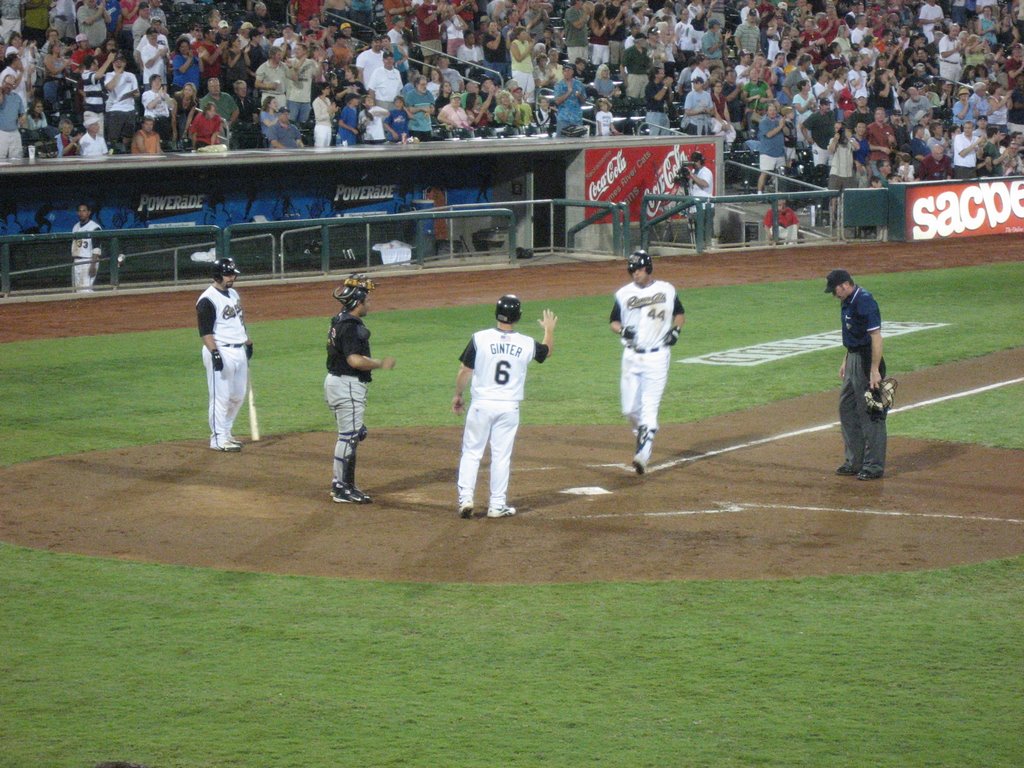
The first shot here is the game winning strikeout. You can see Dinger's hand in the bottom right. The second is Keith Ginter greeting Scott McClain as they scored the last two runs. McClain won League MVP honors which is something of a tradition for the Rivercats. With more than 100 RBIs that is something which was not completely unexpected.

Thursday, August 31, 2006

What was in the koolaid at MSNBC?

Last night Keith Olbermann offered a homage to Edward R. Murrow. It was a pale homage but a homage none-the-less. His six and a half minute rant against a speech that Secretary Rumsfeld gave to the American Legion was bizarre. He accused Rumsfeld of all types of sins. He suggested that Rumsfeld is trying to stop any dissent. Olbermann's conclusion is that Rumsfeld should be compared to Chamberlain not Churchill. Chamberlain, in the lead up to the war, tried to assail Churchill in all sorts of ways. And he thought the secretary's criticisms of opponents of the war was Chamberlainesque.

Olbermann raised the specter of Rumsfeld benefitting "personally" and professionally from his policy decisions. So he got us into the war to gain personally? Isn't that a bit over the top? He also raised the specter of Nixon, McCarthy and Curtis LeMay as a harbinger of what Rumsfeld was like. He used grainy photos of Hitler and a whole bunch of images to present a picture of sinister evil. I am not sure what brought about this vitriolic response. Perhaps it was koolaid on the set, or as Dickens suggested an underdone piece of potato.

Rumsfeld, I believe correctly, raised questions about two areas in the speech about the opponents of the Middle East policy. From my perspective he was presenting his beliefs and not questioning the patriotism of the opponents. He asked why the coverage of the war in Iraq has missed some major stories? Their coverage, to a lot of observers, seems one sided - accentuating negative aspects of the policy (and there are many) and ignoring positive developments. That is a legitimate question that a senior official should ask. He also asked whether those who want to get us out of Iraq immediately, have a legitimate plan and whether they recognize the threat that the country faces. Those are questions that should be raised. They do not question the patriotism of people who disagree. Yet, Olbermann for some reason decided to present a false picture of Rumsfeld's speech. Is it that he believes that judgments about what should go on MSNBC are not subject to question? Is this the arrogant authority that Olbermann attributes to Rumsfeld?

I think there are many reasons to question the President's policies in Iraq. But there are also many reasons to question the judgment and coverage that the mainstream media has chosen to offer to the American people on issues in the middle east.

There is, and in my opinion there should be, a vigorous debate about the appropriate historical analogy we should use to confron the perils of these times. What can we learn from history? Chamberlain did indeed attack Churchill. But at the same time he had no idea or even a willingness to confront Hitler and his moves at a time when it could have been accomplished. Olbermann's attempt to shift the focus was absurd. But then when he so obviously tries to copy the work the hackneyed phrases out of Good Night and Good Luck (which in my opinion was a hackneyed view of the times of Edward R. Murrow) his criticisms sound like so many harpies chattering.

I had the experience of seeing Olbermann's rant before I read the speech. When I read the speech I was amazed at Olbermann's outrageous claims. Presented below, in its entirety, is Rumsfeld's speech to the American Legion. You judge whether Olbermann was off his meds last night.

Text of Secretary Rumsfeld's speech to the American Legion -

Tom [American Legion Commander Tom Bock], I understand that your son is flying a Chinook in Iraq -- following in his dad's proud tradition of military service. Our country is deeply grateful to him -- and to all of you who have children or relatives serving in our nation's military.

They are in our thoughts and prayers. Please tell them we appreciate all they do for our country.

I thank each of you for the love and support you provide for our troops every day.

No one is more proud of those young people than their Commander-in-Chief. I know that President Bush is looking forward to being with you on Thursday.

We are truly fortunate to have a leader of resolve at a time of war. Through all the challenges, he remains the same man who stood atop the rubble of lower Manhattan, with a bullhorn, vowing to fight back; the leader who told a grieving nation that we will never forget what was lost; and the determined President who works every day to fulfill his vow to bring the enemy to justice or to bring justice to the enemy.

Our nation is so fortunate to have the American Legion standing up for all those who are serving our country in this time of testing.

About a year ago, I participated in the dedication of the World War II Memorial in Washington, D.C. And when I looked out into the audience, I could see a great many American Legion caps. It was a reminder of the millions who sacrificed for our country, so many of whom did not come home.

And it was also a reminder of all that American Legionnaires do to for our servicemen and women. Indeed, through nearly nine decades of service, the American Legion continues to find new ways and to undertake new initiatives to embody their motto: "For God and Country."

The Department of Defense is proud to be a partner with you in the "Heroes to Hometowns" program, which is helping severely wounded veterans with job searches, their homes, and other activities to aid the transition to civilian life. Your partnership with the "The America Supports You" campaign helps communities, organizations, and individuals across this nation express their appreciation to our troops, and to their families.

And, on a personal note, I commend the American Legion for its sponsorship of the Boy Scouts. I know there are some places where Boy Scouts are a subject of scorn.

Well, I was a proud Cub Scout, then a Boy Scout; then an Explorer Scout; an Eagle Scout; and, in 1975, a Distinguished Eagle Scout. The Scouts represent some of the best qualities in our great country -- and they certainly deserve our support!

The American Legion has achieved a great deal for our country since its founding in the months following World War I, when those folks came together in a hotel in Europe to find a way to help some of their fellow veterans who would be coming home soon.

Indeed, that year -- 1919 -- turned out to be one of those pivotal junctures in modern history -- with the signing of the Treaty of Versailles and the creation of the League of Nations -- a treaty and an organization intended to make future wars unnecessary and obsolete.

Indeed, 1919 was the beginning of a period where, over time, a very different set of views would come to dominate discourse and thinking in the west.

Over the next decades, a sentiment took root that contended that if only the growing threats that had begun to emerge in Europe and Asia could be appeased, then the carnage and destruction of then-recent memory of World War I might be avoided. It was a time when a certain amount of cynicism and moral confusion set in among the western democracies. When those who warned about a coming crisis -- the rise of fascism and Nazism -- were ridiculed and ignored.

Indeed, in the decades before World War II, a great many argued that the fascist threat was exaggerated -- or that it was someone else's problem. Some nations tried to negotiate a separate peace -- even as the enemy made its deadly ambitions crystal clear.

It was, as Churchill observed, a bit like feeding a crocodile, hoping it would eat you last.

There was a strange innocence in views of the world. Someone recently recalled one U.S. Senator's reaction in September 1939, upon hearing that Hitler had invaded Poland to start World War II. He exclaimed:

"Lord, if only I could have talked with Hitler, all this might have been avoided."
Think of that!

I recount this history because once again we face the same kind of challenges in efforts to confront the rising threat of a new type of fascism.

Today, another enemy -- a different kind of enemy -- has also made clear its intentions -- in places like New York, Washington, D.C., Bali, London, Madrid, and Moscow. But it is apparent that many have still not learned history's lessons.

We need to face the following questions:

* With the growing lethality and availability of weapons, can we truly afford to believe that somehow vicious extremists can be appeased?

* Can we really continue to think that free countries can negotiate a separate peace with terrorists?

* Can we truly afford the luxury of pretending that the threats today are simply "law enforcement" problems, rather than fundamentally different threats, requiring fundamentally different approaches?

* And can we truly afford to return to the destructive view that America -- not the enemy -- is the real source of the world's trouble?

These are central questions of our time. And we must face them.

We hear everyday of new plans, new efforts, to murder Americans and other free people. Indeed, the plot recently discovered that would have killed hundreds -- possibly thousands -- of innocent men, women, and children on planes coming from Britain to the United States should have demonstrated to all that the enemy is serious, lethal, and relentless.

But this is still -- in 2006 -- not well recognized or fully understood. It seems that in some quarters there is more of a focus on dividing our country, than acting with unity against the gathering threats.

We find ourselves in a strange time:

* When a database search of America's leading newspapers turns up 10 times as many mentions of one of the soldiers at Abu Ghraib who was punished for misconduct, than mentions of Sergeant First Class Paul Ray Smith, the first recipient of the Medal of Honor in the Global War on Terror;

* When a senior editor at Newsweek disparagingly refers to the brave volunteers in our Armed Forces as a "mercenary army";

* When the former head of CNN accuses the American military of deliberately targeting journalists and the former CNN Baghdad bureau chief admits he concealed reports of Saddam Hussein's crimes when he was in power so CNN could stay in Iraq; and

* It is a time when Amnesty International disgracefully refers to the military facility at Guantanamo Bay, which holds terrorists who have vowed to kill Americans and which is arguably the best run and most scrutinized detention facility in the history of warfare, as "the gulag of our times."

Those who know the truth need to speak out against these kinds of myths, and lies, and distortions being told about our troops and our country.

The struggle we are in is too important -- the consequences too severe -- to have the luxury of returning to the old mentality of "Blame America First."

One of the most important things the Legion has done is not only to serve, and assist, and advocate as you've done so superbly for much of the past century -- but also to educate and speak the truth about our country and our military.

Not so long ago, an exhibit on the Enola Gay at the Smithsonian during the 1990s seemed to try to rewrite the history of World War II by portraying the United States as an aggressor. Fortunately, the American Legion was there to lead the effort to set the record straight.

This watchdog role is even more important today in a war that is to a great extent fought in the media on a global stage -- to not allow the lies and the myths be repeated without question or challenge -- so that at least the second and third draft of history will be more accurate than the quick first allegations.

You know from experience that in every war there have been mistakes and setbacks and casualties. War is, as Clemenceau said, a "series of catastrophes that results in victory."

And in every army, there are occasionally bad actors -- the ones who dominate the headlines today -- who don't live up to the standards of their oath and of our country.

But you also know that they are a small percentage of the hundreds of thousands of honorable men and women in all theaters in this struggle who are serving with humanity and decency in the face of constant provocation.

And that is important in this "long war," where any kind of moral and intellectual confusion about who and what is right or wrong can severely weaken the ability of free societies to persevere.

Our enemy knows this well. They frequently invoke the names of Beirut and Somalia -- places they see as examples of American retreat and weakness. And as we have seen most recently -- indeed, this month -- in Lebanon, they design attacks and manipulate the media to try to demoralize public opinion. They doctor photographs of casualties, use civilians as human shields and then provoke an outcry when civilians are accidentally killed in their midst.

The good news is that most of the American people, though understandably influenced by what they read and see in the media, have inner gyroscopes and good centers of gravity.

And I am confident that over time they will evaluate and reflect on what is happening in this struggle and come to wise conclusions.

In Iraq, a country that was brutalized and traumatized by a cruel and dangerous dictatorship is now undertaking the slow, difficult, and uncertain steps to secure a new future, under a representative government -- one that is at peace with its neighbors, rather than a threat to their own people, their neighbors, and to the world.

As the nature of the threat and the conflict in Iraq has changed over these past three years, so have the tactics and deployments. But while military tactics have changed and adapted to the realities on the ground, the strategy has not -- which is to empower the Iraqi people to defend, govern, and rebuild their own country.

The extremists themselves have called Iraq the "epicenter" in the War on Terror. They mean it. And our troops know how important completing the mission is.

A Soldier who recently volunteered for a second tour in Iraq, likely captured the feelings of many of his peers. In an e-mail to friends he wrote:

"I ask that you never take advantage of the liberties guaranteed by the shedding of free blood, never take for granted the freedoms granted by our Constitution. For those liberties would be merely ink on paper were it not for the sacrifice of generations of Americans who heard the call of duty and responded heart, mind and soul with 'Yes, I will.'"
Someday that young man may be a member of the American Legion, attending a convention such as this. I hope he will be. And one day, a future speaker may reflect back on this time of historic choice -- remembering the questions raised as to our country's courage, dedication, and willingness to continue this fight until we have prevailed.

I believe the question is not whether we can win. It is whether we have the will to persevere.

I believe that Americans do have that steel. And that we have learned the lessons of history, the folly of turning a blind eye to danger, and of ignoring our responsibilities. These are lessons you know well -- lessons that your heroism has taught to generations of Americans.

May God bless each of you. May God bless the men and women in uniform and their families. And may God continue to bless our wonderful country.

Wednesday, August 30, 2006

Giddyyup going and went


This was the next to the last home game for the Rivercats. Had things been different it would have been an exciting end to a tumultous season. The Cats, about a week ago, were closing in on 5 games down, playing the hapless Fresno Grizzlies. The Sidewinders were in first, but their lead was diminishing. Now a little more than a week later Tuscon has won 9 in a row and we've lost the first three of the last home series. Tacoma also faded. For the games in this series the Cats have been listless. I guess I can understand the feeling. A minor leaguer has two options at the end of the season. If the team goes into playoffs they and the player is not called up they continue to get their monthly pay (which is less than $2200 per month). There may be some side payoffs for winning but not much. If the player does not go to the bigs on the September 1 call up date (and this year the As are likely to call a couple of Cats up - ideally Thomas, McClain, Johnson, and Flores and Windsor) then a couple of days after the start of the month they are done and can go home or to the Fall leagues in sunnier climes. So for most of these three games the Cats seem to have had their mind on other things.

As I think I said earlier in the season, when they were far behind. This has been a season for character building. Their lack of pizazz in the last few games has been pronounced. Tonight, the umpires sucked. No other word for it, they sucked. The homebase guy who should be doing the judging for dog shows, had a strike zone that was variable. Sometimes it was about six feet wide at other times it was less than two - what's more he could vary his zone by pitch not by batter. The first base guy was even worse. In one call that went against the Cats, our guy beat out a throw to first, the Sidewinder first baseman actually stepped off the base and the moron still called him out. The crowd in our section was downright surly to that call. Officiating in this season has not been ideal - but then as I commented, this has been a character building season and even without those lousy calls, the Cats did not have enough moxie to produce runs and stop the opponent's runs.

The picture, by the way, is earlier in the season,before Dan Johnson made his trip to the bigs. The white spot at the right side of the picture is the ball coming to him.

How to win elections

It is rare that I would write about the wisdom of James Carville and Paul Begula. They run something called the Democracy Corps and published a note today about the Virginia election and why James Kilgore did not win. Their suggestion - it comes down to a positive campaign, and mobilize your base. An addition is that the internet - much as it has been touted - at least for the 2005 election - is not a magic bullet. Carville was one of the authors of "It's the economy stupid" - While I do not agree with how he used the issue (I think he fell into the trap discussed below about optimism and pessimism) - the message is the right one.

Then comes something from the Democratic Strategist which frets about the democrat's alienation of the middle class. That idea has always been an elusive one. It certainly tripped up Jimmy Carter in his presidential race - where he wanted to increase taxes on all people above the median income. They have two suggestions which are powerful. First, think a bit more carefully about who the middle class really is. When one looks at all of the incomes in society one happy group. Indeed, if you look at the economy in those terms the median family income is about $45,000. But if you separate out the people who are most likely to work and contribute to society (29-59) the median jumps to $63,000. That is a big difference. The strategists also look at five key issues where the democrat message is not on track with the vast majority of voters. #1 - pessimism versus optimism. The American people are optimistic. 80% of the American people think it is possible to start and poor and end up rich. That is why the campaign to end the "death tax" was so profound. Pessimism implies passivity and helplessness. That is not where we are as a people. #2 - Economic decline v. strength. When 70% of the American people own their homes it is hard to convince them that we are in fundamental decline. #3 - Economic security versus individual opportunity - while this is not an absolute Americans want to be concerned with opportunity. Security is a good issue, opportunity is a better one. #4 - Most progressive ideas don't benefit the middle class - one need only look at the way the Alternative Minimum Tax has begun to hit those taxpayers. Pell grants - average $19,460 income. 2.7% of the employees in the country earn the minimum wage. #5 How to characterize the conservatives - is the problem big corporations or big government? 61% chose big government to 27% for big business. High percentages of workers like their jobs. Less than 25% of all Americans identified themselves as either upper or lower class - that is a very big middle.

Both threads are things which would help both parties be more successful with voters. They might also get us back on more important issues of public policy. In the end it might also reduce the role of spinmeisters in the political process. All of those trends would be positive.

A Challenge


I have one shot that was posted on my blog several months ago of Naolinco. It is part of my Flickr site which has almost 6000 photos. But this one consistently comes up and people seem to click into it a lot. This is another shot taken the same day.

Naolinco is a colorful town in the state of Veracruz. It has a rich history and is one of the best leather industries in Mexico (great bootmakers). and an martyr (Fr. Dario) from the Christero period. The story of Fr. Dario is compelling. He was a new priest after the enactment of the Tejeda law - which was named after the governor of Veracruz who wanted to reign in the church. The decree was designed to reduce the number of priests in the state. Soon after it was promulgated, soldiers entered the small church where Fr. Dario was and they opened fire and in the melee killed him and gravely wounded several other priests. When I first saw his picture it looked amazingly like a Chilean friend I have who works at a university in Mexico City.

But I wonder why that photo gets clicked through so many times. I am interested not concerned about this. Can anyone who has clicked through the photo explain it to me?

Kudos to Autowest Honda

In February I bought a Honda S-2000 - which is a great car - fun to drive, with lots of pep - exactly what a sportscar should be. It was described to me, at the time of delivery, as a "swiss watch" - with all the precision that implies. And, with one minor exception, that is exactly how the car has performed.

The one minor exception was the Honda Ipod link. I purchased it when I bought the car. For whatever reason, the device was unreliable. I would take it back to the dealer (I think in the end four times) and they would be able to get it to perform for about a day. The sound quality was always inferior. So last week, I went back to the dealer. I spoke with the service person and said I was dissatisfied with this accessory. We talked about whether it could be repaired. I said after the several times I had had it in the shop, I thought it could not. I asked them to pull the unit and wanted a refund. Yesterday, Autowest sent me a refund check to cover the cost of the unit and the installation.

One of the reasons I switched from a Mustang to a Honda (besides the design changes in the Mustang which made it a lot less nimble) was some real problems I had with my Ford dealership. When I was in college I worked as a mechanic and I decided upon graduation that I did not want to spend my free time working on cars. So when I buy a new car, I am also buying service. The Ford dealership would follow up each service call with a questionnaire which asked about the quality of service (which in this particular dealership declined rather markedly from the time I bought the car to the time I sold it). But in the case of the iPod link and Autowest what I found was two things different. First, they genuinely tried to solve the problem I had with the device. But second, when it became clear that the device would not work to standards, they stood behind it and promptly refunded my money. In the long term, any business can maximize their short term profits by extracting as much as they can out of each customer or they can choose to try to meet their customer's needs for the longer term. Autowest seems to have chosen the second course. It is refreshing to find an auto dealer who understands that kind of service, which will ultimately build better brand loyalty.

Developments in Higher Education

There is a news service called Inside Higher Education which is very good. For years the sector has had something called The Chronicle of Higher Education which is our supposed "trade" paper but in recent years it has been taken up in selling ads for positions and in political correctness which has diminished its utility. The founders of Inside Higher Education came from the Chronicle. But their attention to finding stories which are current and interesting puts them in a different league.

In this morning's news digest there were two very interesting stories. First, about James Madison University and the orange band initiative. James Madison has instituted this new program for students to be able to signal to other students that they are prepared to engage in civil dialogue. What a wonderful idea, a tag to indicate civility. Universities should be places where those kinds of deep discussions are common. But in today's overheated environment, that is not the norm. The idea should spread. Think of the possibilities! On political talk shows people show up with orange ribbons or bands and then begin the kind of discussions about the key issues of the day instead of shouting matches. Politicians in even numbered falls don an orange band to show that they are serious about the jobs they are running for instead of simply trying to pander to part of the electorate.

The second story is a bit more troubling. The Alliance for Excellent Education has published a report of the costs of remedial education in community colleges across the country. Their estimate, $1.4 billion. The Alliance's estimates do not include the costs associated with remedial courses or work in four year institutions so the authors think the number is conservative. One validation of the estimate came from an official in Alabama who did their own statewide estimate and came up with a figure which was twice the size of the Alliance estimate for their state - so the total number could be considerably higher. Assume for a moment that the total size of the enterprise as a part of the American economy is in the range of $30-40 billion, even a doubling of the estimate for these programs does not seem unreasonable. Sure it is easy to blame K-12 education - and there should be some blame. But the costs of remediation also include the discontinuities of people who make changes in their plans (for example a person who is 30 and decides to change careers and needs to go back for some basics). The strength of the American higher education system is its ultimate flexibility. Regardless, it is interesting to have an estimate of that part of the system.

Tuesday, August 29, 2006

The new concept of democracy - According to AMLO - Mexican Election Post #22

The head of the election tribunal came close to the final determination on the Mexican election by suggesting that save about 4000 votes Mr. Lopez Obrador failed to win (he lost). But wait.....

#1 - AMLO has suggested that he will give his own Grito on independence day (September 16) and declare himself president. but #2 - Polling is turning against this self styled messiah. In a poll released in the Wall Street Journal the following responses were reported -

a) Do you agree with AMLOs resistence to the election results - NO 68%, b) Based on what you know who do you think won the July 2 election - Calderon 62%. c) If the election were held today who would you vote for Calderon 54% (on July 2 37%), AMLO 30% (on July 2 36%), Madrazo 12% (on July 2 23%) - thus support for Calderon has come at the expense of both Madrazo and AMLO.

Finally, (based on a 10 point scale with 10 being high) - How would you rate the following - The voters in the July 2 election (8.2), The electoral tribunal after the election (7.1), Calderon's conduct after the election (7.1), AMLOs conduct after the election (4.1).

The Wait

With the win by the Sidewinders on Sunday the hunt for the division championship was over. Last night's game with the Sidewinders had a certain anti-climactic feeling to it. Adam Pettyjohn pitched a reasonably good game except for a disastrous first inning where the Sidewinders scored 6 runs. For the rest of the game we scored 4 runs they scored 1 - but those first six put the game out of reach. There are three games left at home with the Sidewinders and then a weekend series against Colorado.

Last night involved a lot of chatter in the stands. In our area there was wonder about whether the Keystone Kops of Boulder, now that Mr. Karr has been found to not have been involved, would be flown back to Thailand and whether the papers would cover his meal as closely as they did on the trip east. There was also some excitement on Baseball Bingo - had they run one more inning I would have won - for the first time ever - Jeremy Brown got a single in the eighth. But like the rest of the season, the two grass seats for a future game (which is the prize bestowed on winners) was not to be.

After Thursday night, which coincidentally is also the last night of the legislative session, the wait for April's opening night comes again. There are the playoffs - and if Tuscon plays like they have all season, they should win. They could conceivably win 90 games this year (which was where the Rivercats were in one of their PCL championship seasons).

Monday, August 28, 2006

Interesting economic facts

In today's NYT there is a story which I found a bit strange. The title was "Real Wages Fail to Match a Rise in Productivity." The story comments "The median hourly wage for American workers has declined 2 percent since 2003, after factoring in inflation." After discussing some data about how wages have changed over time in relation to productivity changes the article quotes Jared Bernstein, who is at the (liberal) economic policy institute. (The Times notes that by the way.) He says “If I had to sum it up,” said Jared Bernstein, a senior economist at the institute, “it comes down to bargaining power and the lack of ability of many in the work force to claim their fair share of growth.” If the trend is indeed true, if I had to sum it up I might look at a lot of other factors. The decline of unions (bargaining power) may not be one of them - although it is a frequent topic of the Institute. There are lots of alternative explanations.

In rapid fire succession the Times then presents a series of conclusions that seem to contradict Bernstein's spin "Nominal wages have accelerated in the last year, but the spike in oil costs has eaten up the gains. Now the job market appears to be weakening, after a protracted series of interest-rate increases by the Federal Reserve." (Comment - the relative importance of oil in the economy is considerably diminished in recent years - so Bernstein's conclusion may not be true.)

"Unless these trends reverse, the current expansion may lack even an extended period of modest wage growth like one that occurred in the mid-1980’s." (Comment: but only if these trends are a) real and b) continuing.)

"The most recent recession ended in late 2001. Hourly wages continued to rise in 2002 and peaked in early 2003, largely on the lingering strength of the 1990’s boom." (Comment: but nominal wages increased in the last year - presumably that is beyond 2003 and average family income adjusted for inflation (see below) has advanced at a good clip.)

"Average family income, adjusted for inflation, has continued to advance at a good clip, a fact Mr. Bush has cited when speaking about the economy. But these gains are a result mainly of increases at the top of the income spectrum that pull up the overall numbers. Even for workers at the 90th percentile of earners — making about $80,000 a year — inflation has outpaced their pay increases over the last three years, according to the Labor Department."

It then goes on to fret whether there is substantial movement in the electorate about this set of issues.

Then comes something from economist James Galbraith. He suggests that the seeming changes in wage inequality can be substantially discounted by eliminating the data from only five counties in the US (Manhattan, King's County(WA), San Mateo, Santa Clara and San Francisco. That suggests, at least for me, that the quick rise in incomes for computer entrepreneurs and some financial managers has distorted our understanding of what the whole economy is doing. That should give us greater caution when looking at a bunch of other statistics - for example, do we have a firm understanding of the part of a family's income wages make up? Has that changed in all income classes over the last couple of decades? Have consumption patterns for families changed over time? (for example, is gas really less important to the family budget?)

What is the point here? Is the economic position of the average wage earner declining, holding steady or advancing? In this case the common logic may not be correct.

Was Larry Ellison right? Network computing.

About a decade ago, when Larry Ellison was trying to buy Apple for a song, he was interviewed by Wired or Red Herring about the future of applications. He commented that he thought that network applications and appliances would be the thing of the future. At the time Microsoft was in full swing and the increasingly complex suite of Office products was being updated frequently. Individual productivity seemed to be the trend of computing - create it on your own desktop and then collaborate using the features in the program that allowed one to share.

With Google's introduction of a credible word processing and spreadsheet, which follows earlier versions of similar products in an open source environment, Ellison's vision may be coming true. What makes all of this possible is two things which most people did not recognize at the time. First, the ubiquity of bandwidth continues to expand. As faster and faster connections become not just possible but consistently available, the need to carry all of your stuff together becomes less critical. Second, is the declining price of storage. In the early 1990s a local computer vender was going out of business and was selling 20 megabyte hard drives for $1 per megabyte. I recently decided to install a media storage device in my home network which will, when fully loaded, contain all of my photos (which currently number about 10,000 and increase by 4-5000 per year). I went to my local Fry's and bought a half a terabyte drive for a couple of hundred dollars. Think of a megabyte as 1,000,000 pieces of information - not photographs but individual units of information. A terabyte is 1,000,000,000 pieces. To give you an idea about how much is in a terabyte - 20 of them would be enough to house the printed text contents of the Library of Congress. So I just bought a disk drive to store my photos and other media which is equal to about 1/40 of the Library of Congress. Ancestry.com recently housed all of the US Census records on its system from 1790 to 1930 and that consumed 600 terabytes.

Where I think Ellison was not on the mark comes from the inherent human need to add something. The default spreadsheet software for the last decade or more has been Excel by Microsoft. It has a range of great functions and capabilities. But it also has some annoying habits and is visual capabilities - telling a numbers story in a way that non-number oriented people can be comfortable with is limited. When Excel was getting going there was a great competitor called Wingz, it is one of those footnotes of computing that should not be forgotten. Wingz had wonderful capabilities to convert dry numbers into rich pictures. But the product ultimately failed. In the presentation arena there is Microsoft Powerpoint. Again it does a reasonable job at putting together presentations. But it fails in several areas. Along comes Keynote - which is available only for the Macintosh market at this point - which does all sorts of fancy things that Powerpoint could never dream of. As computing begins to migrate out of closed operating systems like Windows toward more Unix based systems (in the Mac world as the company has moved from its Motorola chips to Intel it has created an operating system based on Unix that produces "universal" applications - which can run on a couple of platforms) the possibility for smaller applications that meet individual creativtity needs and are accessible over networks becomes more of a reality.

Ellison based his thoughts on Oracle being the center of the new universe. For a lot of reasons (thankfully) that has not come to pass. But the idea that networks would offer the kind of flexibility that they do today and that they promise in the future seemed quite fantastic just a decade ago.

The worst President of the 20th Century Yaps again, and again

In yesterday's Sunday London Telegraph Saint Jimmy commented "Tony Blair's lack of leadership and timid subservience to George W Bush lie behind the ongoing crisis in Iraq and the worldwide threat of terrorism." Carter seems to have no understanding of the role of former presidents. But that should not be surprising, he had no clue about the role of current presidents, when he was one.

Perhaps his next step is to journey to New Hampshire and join up with a soon to be former professor there named William Woodward who believes an " 'elite' group within the federal government orchestrated the September 11th attacks on America." according to the Manchester Union Leader. New Hamshire is a public institution and the political leadership of the state is grumpy about professor Woodward's rantings. Unfortunately, for us, there is no such lever on former presidents.

Carter completely missed the origins the spawning of militant Islam, so it is not surprising that he would be so consistently wrong on how to deal with the current problems we face. Carter's handling of the transition of power in Iran during his administration helped to create the militants that we face today. Feckless would be a kind characterization for his foreign policy. After he unceremoniously dumped the Shaw of Iran he then allowed the new regime to hold a group of Americans hostage. He tried one attempt to rescue them in April of 1980 where the kindest of analysts suggest he screwed up. Yet he continues to comment on lack of leadership. Perhaps he is commenting from the distinguished chair of studies for bumbling leadership that he could occupy at any academic institution.

Sunday, August 27, 2006

A response to a post on the election

Last night my August 24 post on the election in Mexico drew the following response -

The issue in Mexico is not the numbers, but a distrust that no matter how hard the IFE has tried to separate itself from politics and look only at the technical aspects of the election, there is a significant number of people who believe the election results were manipulated.

It is not about logic, it is about emotion. The history of the country, starting from the first hand over of power in Post-Spanish Mexico, and repeatedly in the 19th and 20th centuries, has shown that Presidents stay in power not by election but by designation. Some of the greater presidents....Juárez, even the controversial Díaz, Lázaro Cárdenas, López Mateos, De la Madrid and I would argue even Zedillo came to power by designation rather than by clean elections.

I agree with you, Calderon will have to move away from his hard core supporters and garner coalitions with the legislature and with State Governors. Your post on region states by Ohmae is a way to go. Calderón should focus on Justice and coordination and let the economic development of the country be squarely in the hands of the governors and more local organizations.
Vperez | 08.27.06 - 1:16 am |

I agree with a good deal of the comments. But I also have a couple of additional thoughts. First, I recognize the emotions in a group of people who are skeptical about the election. Ultimately, even if the election was done to the highest international standards, based on the history of elections in the past (see my post about which year this is 1988,1994 or 2006) the Mexican people have a lot to be skeptical about. Mexico's electoral system is an evolving one. I believe that the 2006 election held to the highest standards. One election does not make a trend - but the direction, in my opinion, was positive.

Second, in my opinion, regardless of whether the objective reality confirms a good election, Mr. Lopez Obrador has tried to exploit the underlying skepticism of some people about elections in Mexico to his own advantage. The best example of that was the "stuffing" allegation. Soon after the election Lopez Obrador made a claim, when the election official came forward (his own PRD official) and presented a good explanation of what was going on in the video, AMLO said the guy had been "bought off." AMLO wants to return to the old system where elections were designated. There once was a joke in Mexico about the moving finger - the next president was chosen by the previous one. Until the 2000 election, that happened with varying degrees of designation. But 2000 broke that trend. I believe 2006 - where Mr. Fox wanted another candidate to be the PAN candidate - continued the trend begun in 2000.

Third, and most important. The Mexican constitution is a federal system. Under the PRI, like many other provisions in the document federalism was a fiction. All power resided in the national government. But in the last several years that has begun to change in some areas of the country. I have worked with a couple of governors, most notably Luis Armando Reynoso Femat in Aguascalientes, who understand the benefits of a federal system and have made major strides to try to move their states toward a more federal reality. Luis Armando has worked hard to make his administration into a world class team working for the state. His key secretaries could do their jobs in any region of the world. In the states around AGU similar things are happening, even though they are not PAN states. I got the same feeling from speaking with key officials in Zacatecas, a PRD state. Like the transition in the electoral system this is not an instantaneous transition. It will require some strong willed governors regardless of who is president. But as I see the evolution of the Mexican political system that is happening.

When Magic Numbers no longer count then miracles do

Last night the Rivercats lost to a team they have dominated all season for the third time in a row. At the same time the Tuscon Sidewinders won their fifth straight in three days against the Tacoma Raniers. (Actually the number of the Raniers losses is six but the two double header wins in a row plus one last night is impressive enough on its own!) With 9 games left we are nine games out. That means Tuscon who is playing .622 ball must lose 9 straight and Sacramento must go on a 9 game winning streak - which would be the longest of the season. None of that is impossible, just very, very highly improbable.

All season in our section we have been commenting about how this has become a "character building" season for fans. In the first six seasons we won a lot of championships. This year at many times it did not look possible to repeat. The last four home games will be fun none-the-less. Although now the stakes are different.