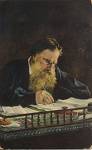
Tuesday, November 21, 2006

Near the end in War and Peace


In the end, Pierre gets the girl, Natasha. Nicolai does too - Princess Maria. But Tolstoy, thinking that his readers would not get enough of the story of the Rostoffs and the Bulkonskis, publishes an epilogue which ties the stories together. The domestic life of the two couples (mentioned above) gets discussed in pretty good detail and with some philosophical thoughts about wedded bliss.

But there is a second epilogue that IMHO is the more important one. Tolstoy has teased us continuously with the question of why things happen in history and in this final set of chapters he goes about trying to answer the question. This is not exactly an easy question. Is it culture, events, power/leaders or ideas? He writes a fairly biting critique of each of the factors as the determinative issue. He wonders why at one point a leader is a hero and at another soon after a goat. I suspect that any political science professor could rip the second epilogue - reprint it and generate some very interesting and thoughtful discussions in a beginning political science class or even an advanced one. His answer, by the way, is that history is created by the interactions of individuals - sort of a want of a nail the shoe was lost motif - but his conclusions are well thought out and well demonstrated.

There are several passages in the novel where Tolstoy gets to these kind of major questions - but this second epilogue is among the best part of his writing. It is the dollop of wisdom at the end of very long trek. But I found the section to be wonderful. I hope to finish the book before Thanksgiving.

There is one other issue that has run through my mind while I have been reading this. A lot of the novel is interior commentary. The asides here are critical. So I wondered whether the novel could be put to film. There were two attempts. The first, is a King Vidor version in the mid-fifties. I saw that one and thought that some of the characters (Audrey Hepburn as Natasha) were perfect but others (Henry Fonda as Pierre) were lacking. Fonda is a bit a shucks for this kind of role - he was clearly miscast or thought he was in another role. He is naive but not the kind of naive that Pierre is in the early part of the novel. The movie is a lot like classics illustrated. While many of the important scenes are recreated, others are not. It lacks the intensity of the book and at the same time misses the fundamental transformation of Pierre. Thus, Vidor's decision, which I believe was a wrong one, was to avoid as much as possible the interiors of the novel. You will remember that in the Woody Allen parody of the novel the interiors are done by Diane Keaton and Woody always going back to references to "wheat" - that actually worked as a comedic device but it is also a way to present the psychological factors which help to define the novel. The second version was done by a Russian in 1968. It is seven hours long. I have ordered it from Netflix and will see how it comes out. The reviews of it seem to be pretty good. As I thought about how this might go to the screen, someone like George Lucas might be able to bring it off. What I think it would need is someone who could take the story and divide it into three segments- all inter-related but which take the time and effort to assure that the key elements in the book are covered.

This has been a long project, started in the summer. I have had friends who read this pretty quickly, but I think it is better read in bursts. The friend who urged me to tackle it, said it is the greatest novel ever written. I am not sure about that - but I am sure that it is well worth the investment of time and thought. If you decide to tackle this novel you will invest both.

Commies and Islamofascists - in 3 parts (Part 3)

So what do you do about the errors of the left and the right? Here, although I think I understand the errors of both sides, I am not sure what the appropriate next steps should be. Clearly, a formally established timetable for withdrawal seems like a bad idea. Joe Lieberman, who seems pretty sensible on this set of issues, said as much tonight on Fox. But at the same time, the odd and curious claims made since the declaration of victory by the administration have left us without a clear path forward. Staying the course seems unwise. Yet, I believe that we should recognize the potential for appropriate responses which would break up the efforts by the islamofacsists to move the world away from the trends of globalization that have helped many countries over the past couple of decades.

I am skeptical that the Baker Commission will come up with anything useful. If we had wanted him as president, we could have chosen him. We did not. I think his and his colleagues prescrptions may be a bit off the mark. I also am sure that the firebrands in the Congress who want to play to the crowd are not going to help us resolve a new strategy. Kerry is at best a poseur. Ditto for most of the members of the Congressional leadership - their wartime strategy is determined by a finger in the wind.

What bothers me most about the Bush policies is its inability to deal with the range of issues we face. The world is not unidimensional. Hugo Chavez is an evil force, close to our door. Evo Morales less so, but still negative. Chavez might not have been as successful (even though even he overshot the bounds of propriety in his tirade at the UN) had Bush not been so engaged in Iraq. I am genuinely not sure what would have happened had we decided to stay the course in Afghanistan and allowed that conflict to be more settled.

What also bothers me is the intransigence of our intelligence establishment. It is pretty clear to me that while our intelligence people were clear on the projects they needed to accomplish in the last era - and I think by the end they produced at least reasonable data - in this era, regardless of left of right, they are not prepared to offer us the information we need. The conflict here is global but not governmental.

When the left thinks that Kim Il Jong will act honorably - they are wrong. Albright's (what an oxymoron her name is) attempt to appease the N. Korean's during the Clinton administration was absurd. That she would be surprised when the two bit tyrant went back on his work is surprising. That Madeline Albright still gets airtime anywhere except the comedy channel is also amazing. But if the left is too accomodating the right is often too intransigent. We need to constantly look for nuances - and not just in governments. One of the errors of our intelligence apparatus today is that too much of it thinks that policy is made in government offices.

What we need to think about is how we can develop an intelligence function that can give us the information we need to give us a clear understanding of the world. At least as clear as it is possible to produce. Better intelligence might give us some better notions about how to avoid the errors of the right and the left.

Commies and Islamofascists - in 3 parts (Part 2)

The errors of the right and the left cost us something in the last conflict. The left's underestimations of communist intentions undermined a united position in our efforts to respond. But at the same time the right's overestimation may have had us spend way to much to repel the threat.

Part of that may have been that many on both sides were fighting the last war. In this case, it was WWII.

I believe that RWR took the right stance - he knew the Soviets were a paper tiger and thus played a high stakes game which we ultimately won. Sometimes it is right to make a high stakes bet. As RWR said so eloquently "Trust and Verify." I also believe that some of the left, including Johnson and his cabinet including McNamara and his general including Westmorland, were stuck in an unreasonable position of wanting to repel the commies yet not offend the far left. Thus, in Vietnam we were faced with the worst possible situation - buying the ideas of commiting to the battle with little long term thought of how to be successful.

The Vietnam war was also a defining period of my life. Johnson thought he could run the war from the White House. He did not trust his generals (in my mind with good reason) but he kept inching into a position that ultimately killed 50,000 of my generation for a war we were not prepared to win. McNamara and the other "brilliant" strategists were filled with the hubris of Washington (and possibly Detroit) and their constant reliance on numbers games served us poorly.

A second reality of that experience suggests that democracies are not very good at prosecuting a war - so when you get into a war you need to be clear on objectives and goals. I am not sure that the administration actually thought carefully about that before they went into Iraq. (Although I will admit that the goal of democratizing one country in the Middle East is one concept that I think makes some sense.)

Commies and Islamofascists - in 3 parts (Part 1)

I grew up in the era of of the communist menace. Obviously, as much as I would like to reject that as an influence in my life - it has affected the way I look at the world. It seems to me that there are a number of parallels between the quest to wipe out the Commies and the Islamofascists.

Here are some parallels that I see.

#1 - Both the left and the right misjudge the threats of our enemies. During the period when Communism was the enemy, the left consistently underestimated the threat of communist plots. There really were people who wanted to subvert our governmental system. Despite all of the romanticism of the left, the Rosenbergs were guilty. There is pretty good evidence that some of all of the Hollywood Ten were actively engaged in trying to subvert the American political system. No doubt about it. But if the left under-estimated the threat, the right often over estimated it. J. Edgar Hoover's worry that everyone who did not agree with his odd and curious view of the world was a commie was silly. The Looming Tower, Lawrence Wright's excellent book on Al Quaida said that Hoover thought the ratio of Commies to normal citizens was something like 1:1800. Silly. Martin Luther King was not a subversive. One of my most distinct memories in my work in the House of Representatives was two representatives James B. Utt (I always wanted to eliminate the period in his name) and H.R. Gross - for both of these members, there was a commie under every bed. By the time I began to work in Congress, in 1970, those guys were characatures of real issues.

In today's conflict the right assumes too much about the inter-workings of the Islamofascists and thus potentially ignore the potential for splitting a series of movements where there may be nuanced differences that could be exploited. The left on the other hand dismisses the possibility that there are evil people in the world who may want to work together. There is plenty of evidence that Saadam and Syria and Iran have at times worked together - the notion of the Axis of Evil is not silly. But over commitment in one region by this administration may preclude options we need to consider.

#2 - The Europeans for some good and bad reasons underestimated the threat of communism. In part, because many of the postwar regimes were variants of socialism they thought that socialism and communism were related. Indeed, the common cold and cancer are both diseases - but the naive notion that they were the same is nonsense. In this era the Europeans have striven toward political correctness and thus again have underestimated the perniciousness of the threat. Nuance is helpful but when driven to extremes is nonsense.

#3 - The long term interests of the US needed to include some recognition of the potential monolithic nature of the "communist menace" at the same time, intelligent foreign policy would look at inherent differences. I studied International Relations as an undergraduate. But the left consistently did lousy intelligence on the capabilities of the Communist block. Until right before the eastern block broke up, many on the left argued that a) the soviet block an economic and social powerhouse (witness the still odd responses we hear about Cuba being an island paradise) and b) that the block was not a block. In this era there was a lot of yammering about the capabilities of the groups which are not a single group but which often work in concert.

Monday, November 20, 2006

Aida in Sacramento

The Sacramento Opera company, for its second opera, did Aida over the weekend (also on Tuesday). It was a superb production from staging to voices to the orchestra.

Aida is one of my favorite operas. It was originally written by Verdi to be performed in Egypt (not to celebrate the opening of the Suez Canal). But it was delayed in its opening because of the Franco-Prussian war. Like many of Verdi's other works it has a dozen or so great tunes and a set of recurring themes that keep coming back.

The standout of the evening was Oksana Sitnitska who made her US opera debut with this company. She has a stunning Mezzo voice and wonderful stage presence. She is originally from the Ukraine but I expect her to soon be at the top of the international ranks of singers. But the rest of the cast matched Sitnitska's performance. Hope Briggs was Aida, Drew Slaton played Radames, Ralph Cato was Amonasro and Donald Sherrill was Ramfis, Gregory Stapp was the King.

The sets were from the Met production and are pretty simple but very useful.

Aida is a hard production to mount. I was on the Sacramento board when the company last presented it. We used Llamas for the grand march because it would have cost $100,000 to reinforce the stage to use elephants. To do the opera right requires a pretty big group of lead singers and a large chorus. But this production was masterful.

John Kerry Electoral Genius

Kerry commented over the weekend on how his non-involvement in the last couple of weeks of the election produced a democrat win.

He said "Since we had very close races, I made the decision to make certain that I didn't distract. The results speak for themselves." I guess that is a demonstration of his leadership capabilities, as if we needed another one.

How to lose the majority


Yesterday, the incoming chair of the House Ways and Means Committee renewed his call for reinstitution of the draft. It is odd that Mr. Rangel would renew his call during the week that Milton Friedman died. But such is politics.

Rangel and others argue that the draft is a democratizing force. That is nonsense. Those of us who supported to creation of the All Voluntary Military(I worked for a Senator who was a key supporter of the concept) found that all of the promises of the volunteer force have been realized and none of the risks raised by the supporters of this form of involuntary servitude threw out have come true.

The draft at it was last practiced was called the Selective Service System whose leader was a general named Lewis B. Hershey. It accomplished none of that - it was not selective, it did not perform a service and it was certainly not a system. It was run, as these kinds of bureaucracies are often run, with an indifference to anything but maintaining its own operations. Hershey was blind in one eye (somehow appropriate for his bureaucratic role) and the only person named a general who never served in a combat role - although he served in the military for 62 years. How about that for a role model?

One of the canards raised about the draft is that a president would be loathe to enter a war knowing that he would be sending people who were involuntarily there. The evidence from Johnson's wanton efforts in Vietnam belie that "logic" but Rangel continues to press it.

Rangel's proposal would cost plenty. One estimate is in the range of $800,000,000,000. That assumes that all 18-21 year old males would participate in the process at some point and that some range of young women would also avail themselves of this "opportunity" and that the government would not reduce the pay offered to enlisted soldiers. Even if it is a quarter of that estimate, that is still a chunk of change.

If the democrats begin to push this notion, their majority will be short lived. There is no support for the position in the populace and there are a lot of people in my generation who remember the genuinely bizarre policies that the SSS created. There are few issues that would mobilize me as much as a serious attempt to reinstitute the draft.

Sunday, November 19, 2006

Transformations according to Dickens and Tolstoy


One of the traditions in our household around Thanksgiving is to watch Miracle on 34th Street. But then as we drift to Christmas we begin to watch the different versions of "A Christmas Carol" - I do not know how many times or versions I have seen it - but I like it every time. It is an inane story - but one with redeeming qualities. Scrooge is a bit too miserly. His redemption is a bit too complete. But I still like it every time I see it. My favorite is still the Alistair Sim version.

But after Pierre is rescued in War and Peace he goes through a similar transformation. Both characters, Pierre and Scrooge, are narrow in their orientation before their transformation. Scrooge is focused on money/business and Pierre flits from one fad to another. Both go through an experience - Scrooge the three spirits and Pierre the experience of being captured in the war and then going through the privations of captivity. Both emerge from the experience able to understand the small wonders of life and able to judge life from a much more balanced perspective. The parallels are interesting.

College Football Rankings


(Game Photo from USC)
Last night the USC Trojans beat the Cal Bears. It was an exciting game. I am not a big fan of the BCS system or other college rankings. Those things put too much of an emphasis on things which should not be critical to the mission of colleges or universities. Both Cal and USC care a lot about both the integrity of their schedules. Both, unlike AP third ranked Florida, have played real schedules.

While number 4 and 17 were playing Florida was playing Western Carolina. This came on top of their very rough schedule this year that included such powerhouses as Southern Mississippi and Central Florida.

All of the experts thought this would be a high scoring game - most predicted numbers for both sides in the 35 range and yet it ultimately became a contest of defense. So much for the experts. The best college football games, unlike the NFL, are a bit unpredictable. They are fun because they really do depend in part on emotion and execution.

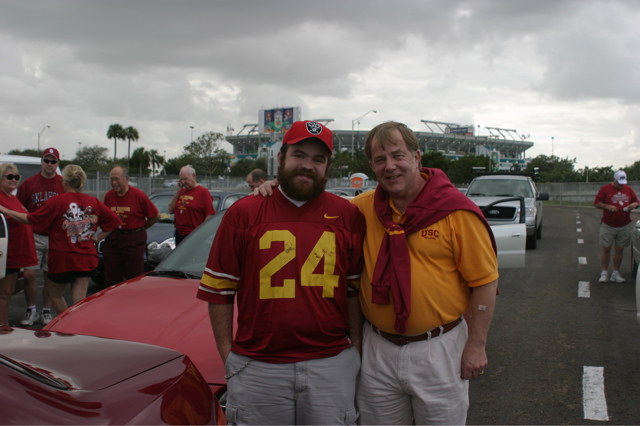
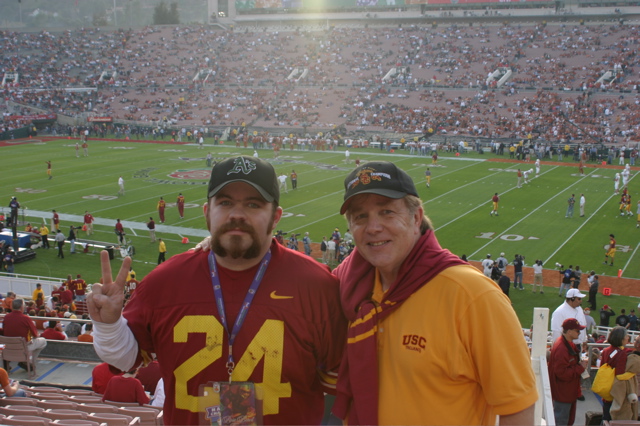
Cal was again disappointed in their quest (since 1959) for the Rose Bowl. USC will, depending on what happens against Notre Dame and UCLA (both games are always emotional and important), either go to the Rose Bowl or to the National Championship. My son and I have been to the last two National Championship games. The two pictures of us are at the Orange Bowl and the Rose Bowl National Championship games. I would prefer to go back to the era when the Rose Bowl was the Pac 10 against the Big 10(12). That was often an interesting game between teams that played real schedules.

Sascha Baron Cohen(Bruno) and Pastor Quinn

You tube has a Sascha Cohen video of a character named Bruno who is a "gay" news guy interviewing a conservative pastor from Little Rock. Cohen as he does with a lot of his "interviews" designed them to make fun of this guy. But as you watch it the video says a lot more. Cohen's attempt at ridicule falls flat to all but the most narrow minded bigots of the left. The pastor presents his views on Christian doctrine relating to homosexuality. They are views that I would not agree with. But they are sincerely held beliefs. Cohen attempts to camp this guy in all sorts of ways. With off the wall questions designed to make Cohen look good rather than to elicit the substance of his beliefs. Some of Cohen's bits a mildly funny but a lot of them are simply pathetic attempts to show how cool he is.

A good deal of TV today starts with that premise. Rather than trying to build a dialogue between people of differing beliefs there is a conscientious attempt to run the other side down. That is where narrow minded bigots, of all shapes and types, come from.

Brad de Long on Friedman

In Salon today UC economist Brad DeLong wrote an interesting tribute to Milton Friedman. He commented in part -

Friedman's thought is, I believe, best seen as the fusion of two strong and very American currents: libertarianism and pragmatism. Friedman was a pragmatic libertarian. He believed that -- as an empirical matter -- giving individuals freedom and letting them coordinate their actions by buying and selling on markets would produce the best results. It was not that he thought this was a natural law. He didn't believe that markets always worked best. It was, rather, that he believed that places where markets failed were atypical; that where markets failed there were almost always enormous profit opportunities from entrepreneurial redesign of institutions; and that the market system would create new opportunities for trade that would route around market failures. Most important, his distrust of government told him that government failure was pervasive, and that any expansion of government beyond the classical liberal state would be highly likely to cause more trouble than it could solve.

The entire article is a good read.

Friday, November 17, 2006

John McCain Makes Sense


John McCain is not a politician I agree with a lot of the time. But I believe in a speech he made to GOPAC, he spoke the truth. In it he said "We increased the size of government in the false hope that we could bribe the public into keeping us in office. And the people punished us. We lost our principles and our majority. And there is no way to recover our majority without recovering our principles first." His speech can be found on his website.

Milton Friedman - Some additional thoughts


I only met Friedman once - at a dinner for an institute at Santa Clara University. He and his wife were there celebrating the creation of an institute designed to give students some background in free market thought. He seemed gracious - he was the star of the evening but seemed to move around the room, always with Rose at his side, talking with almost every guest.

As I was thinking about Friedman I read most of the obits in places like the NYT and the WP. His contributions to advancing the free market were continuous. Yet, at several times he intervened in issues where I was directly working.

For example, he was a passionate supporter of the volunteer army. He had a great comment to General WIlliam Westmorland who had said he was reluctant to lead a band of mercenaries. Friedman encountered him and told of the encounter. "I stopped him and said, 'General, would you rather command an army of slaves. . . . If they are mercenaries, then I, sir, am a mercenary professor, and you, sir, are a mercenary general, and we are served by mercenary physicians, we use a mercenary lawyer and we get our meat from a mercenary butcher.' "

He also was willing to confront cliches. He responded in 1962 to Kennedy's famous soundbite that is was wrong headed. Rather than "ask not what your country can do for you, ask what you can do for your country" he argued, in an introduction to Capitalism and Freedom that You should ask neither. “What your country can do for you, implies that the government is the patron, the citizen the ward; and “what you can do for your country” assumes that the government is the master, the citizen the servant." Rather, he said, you should ask, “What I and my compatriots can do through government to help discharge our individual responsibilities, to achieve our several goals and purposes, and above all protect our freedom.” Not as good a soundbite but a clear understanding of how the world should work.

Friedman worked for the government during WWII in the Department of the Treasury. He commented that it was something his wife never forgave him for. He commented “There is no doubt that it would not have been possible to collect the amount of taxes imposed during World War II without withholding taxes at the source. But it is also true, that the existence of withholding has made it possible for taxes to be higher after the war than they otherwise could have been. So I have a good deal of sympathy for the view that, however necessary withholding may have been for wartime purposes, its existence has had some negative effects in the postwar period.”

The Nobel laureate understood the free market is a real democratizing force. “The free market is the only mechanism that has ever been discovered for achieving participatory democracy.”

My favorite quote from Friedman was one that was reprinted in the WSJ today. "Given our monstrous, overgrown government structure, any three letters chosen at random would probably designate an agency or part of a department that could profitably be abolished." I was reminded of what happened when a friend during the Nixon administration who went to an interagency meeting (he was representing Elliott Richardson at HEW) signed in as the Deputy Assistant Secretary for Aircraft and Sewage and began getting meeting notices for interagency meetings on transportation and solid waste issues.

There were two reflections that were especially important. The first came from a small minded biographer of John Kenneth Galbraith. Richard Parker commented in the Boston Globe last year (and requoted in the WP story) that Friedman's calls for market deregulation had negative consequences. Friedman's "passionate calls for financial and securities market deregulation played no small role in ushering in the half-trillion dollar S&L fiasco of the 1980s and the deeply corrupt Wall Street stock market boom of the 1990s. His tax-reduction-at-all-costs policies helped lead to the nation's yawning budget deficits." Obviously, both conclusions are nonsense. As I remember the S&L crisis came about in part because of democrat leaders like St. Germain who wanted to socialize risk but dramatically increasing the insurance of these accounts while simultaneously attempting to broader their charters. Those were not adherence to free market principles but the opposite. The tax policies advocated by Friedman did not increase the deficit rather increases in spending (which Friedman continuously argued for) did. One should not be surprised that a fan of Galbraith would be so misinformed.

But then there was a more balanced comment from a colleague at Chicago. As noted yesterday, one of the things which impressed me most was Friedman's passionate commitment to reasoned debate. (Something that the political system could benefit from today.) W. Allen Wallis who was both a classmate and faculty colleague said “What was really so important about him,” was his tremendous basic intelligence, his ingenuity, perseverance — his way of getting to the bottom of things, of looking at them in a new way.”

Thursday, November 16, 2006

Milton Friedman


Milton Friedman died today at the age of 94. Friedman was a continuous supporter of liberty and for several generations of students of all types he helped introduce to basic concepts o freedom. I cannot explain how important his ideas were to me personally. I recently was able to download from Google video the episodes of Free To Choose - the PBS series he did about the time of the Reagan Administration. While some of the images are dated, the concepts are not. His understanding of the causes of the depression (in his monumental work on Monetary History) was ground breaking at the time. But I think his major contribution, from my perspective, was his unstinting willingness to engage with others who differed from him on ideas that mattered, always with a polite demeanor and absolute demands of intellectual honesty.

A constant in politics


As I think I have commented earlier, one of my friends who is an astute political analyst (although he is the guy who argued that the democrats would automatically nominate Jane Harman to the Governorship because she is a woman) has recently argued to me that the democrats will be in control of congress - for "the rest of our lives." I have argued that all political parties have the inherent quality to snatch defeat from the jaws of victory. Witness the fight about John (pork is my middle name) Murtha as the majority leader.

But in the NYT today, there is a great story about the problems that the democrats are causing for themselves. Contrary to the common notion (Victory has many fathers, defeat is an orphan) a lot in the democrat party are arguing about who actually won the congress for them. James Carville, never one to be slow on the gab uptake, commented a couple of days ago that Howard Dean was ineffective. Two of his quotes stand out. “There was a missed opportunity here,I’ve sat down with Republican pollsters to discuss this race: They believe we left 10 to 20 seats on the table." and " I would describe his (Dean's) leadership as Rumsfeldian in its incompetence.” Carville has never been cautious about his own ego, so his comments are not surprising. But there seems to be a legitimate discussion about whether Dean or the state leaders were the lynchpin in making things happen for the dems in this election.

A democrat leader from South Carolina commented in the same article “Asking Dean to step down now, after last week, is equivalent to asking Eisenhower to resign after the Normandy invasion,” Donald Fowler of the South Carolina democrats said. “It’s just nonsense."

Elections are about mobilizing one's base and encouraging those close to your base to believe they are also a part of that. Undeniably, despite the almost reverential homage paid to Karl Rove by some, the dems did a better job in accomplishing that. What encourages me is that at this time in American politics all coalitions are fragile and unstable. The American people seem to be turned off by both parties writ large. But in this election they were less turned off by the dems - and that is fine. Those who were applauded for their brilliance in 2004 are now being looked at with differing eyes. One would only hope that self promoters like Carville would be less visible in the future. But then that is too much to hope for.

The long term values of the American people are somewhere in between the big government left and the big government right. Whoever realizes that will have the chance to capture the majority for a very long time. At this point, I am not ready to concede that either side has found that fairly simple Rosetta stone of politics.

Auspicious Beginnings (?)


The leadership contests in Congress are notable for what they are not saying as much as for what they are saying.

Former Abscam figure (an unindicted co-conspirator) and demi-prince of pork John Murtha has been annointed by Speaker designate Nancy Pelosi - it is unclear whether his caucus will elect him. By the way, thanks to U-tube - you can see the grainy video of this "leader" dancing around what the FBI considered a bribe on YouTube. Whether Mr. Murtha broke the law here, and the prosecutors thought it was a judgment call, he certainly skirted the bounds of propriety. Not exactly what I would call a paragon of leadership. Trent Lott, former "leader" in the GOP senate caucus was elected back as a whip in that caucus. Lott was bounced from leadership for some inappropriate remarks about Strom Thurmond. But before he was bounced he was not exactly what anyone would call a visionary leader. Maybe the inside job of Whip is something appropriate to his energies.

The Congressional Research Service produced a report that estimates that earmarks (16,500 in 2005) cost the American taxpayer $50 BILLION last year. The provisions offered to reduce this practice look amazingly like something the GOP offered in this congress which the dems labeled a sham. One of the key provisions requires authors of these measures to be named - which some members of congress point out might be considered a badge of honor. Others would ban last minute adds to bills and would prohibit family members from personally benefitting from earmarks (Murtha's brother is an earmark lobbyist in DC of pretty legendary proportions).

Not surprisingly, the netroots (nutter) crowd is supporting Murtha (30 years) over Steny Hoyer (26 years) for the position as a way to show the new direction of the Congress. The next two years should be even more fun than the last two! The caucus voted for Hoyer this morning - one wonders about the long term implications for that - but I personally think that was the right choice.

Commitment in Higher Education

The interim CEO in a publicy traded company said yesterday "(as our company) positions itself for the future, we will be better targeting our business strategy and concentrating our resources on those areas where we have the greatest competitive advantage, the highest levels of expertise, and proven success." With that the CEO announced that they would sell off thirteen campuses in Career Education's system that had underperformed financially or had other types of problems. Some of these sites were featured on 60 Minutes for their shoddy practices.

There is a continuing debate in many quarters about the superiority of the propreitary sector in higher education. It is claimed that the proprietaries operate more efficiently, meet the needs of students better and succeed in meeting the needs of their local communities more productively than non-profit or public universities. Indeed, some proprietaries do a pretty good job in some areas. But if the cut and run strategy at Career Education is an example of these higher practices, I guess I cannot see it.

One of the continuing parts of the discussion about higher education is whether it is a commodity. Indeed, despite all of the intangibles there is a commodity aspect to it. But the evidence of commitment from the non-profit institutions is quite different than the one that seems to be evidenced by places like Career Education. The company calls itself "leaders in education" but their track record both with these institutions and with the broader context of what they provide suggests that a better title might be exploiters of education. Their commitment is to the bottom line and not to students. While some of the non-profit sector could also be defamed for the same time of lack of focus - many in the non-profit sector have a clear and conscientious commitment to broader goals than seem to be evidenced in this example.

Tuesday, November 14, 2006

Dan Lungren and Leadership

Does Dan Lungren deserve a leadership post in the new congress? According to Adam Probolsky an Orange County pollster the answer is no. But that kind of logic will keep the GOP in the minority for a long time. Dan recognized that earmarks were poison. His neighboring GOP member who was in the leadership - wisely decided to avoid running for leadership again (the little leadership that he did provide). Dan would be a great senior leader.

Dan is not perfect (and then of course who is) and some of the criticisms of Dan's past roles are somewhat valid. But in this case leadership in the Congress depends on judgment. His next door neighbor did not exercise any. Dan did. He deserves to be in the leadership team. He is experienced both in the ways of California politics and in the ways of Congress. He would add something significant to the leadership mix.

Tolstoy on Happiness


I am finally in the home stretch of War and Peace. In an earlier part of the book Prince Andrei and Pierre muse about happiness and Andrei makes the wry comment that Happiness is seen as a negative reflection - i.e. you know when it is not there. Pierre, by this time in the book has been put in prison and almost executed for a foolish attempt on Napoleon. He begins to reflect on his friend's comments and starts to understand them - but in a different manner than Andrei intended them. Pierre, reflecting the best of Hayek or any other Austrian economist (subtle irony here) suggests that happiness is derived from the struggle for it. That people derive satisfaction not from material goods (which Pierre had plenty of) but from the pursuit of happiness. You can notice a change in Pierre here that is subtle but interesting. He drops his foppish attractions to all sorts of causes and begins to understand the true nature of happiness.

This section in the book returns to Tolstoy's discussion of authority. He expressly, in a long passage about Napoleon's orders and intentions in occupying Moscow, explains the concept of epephenominality (one of my students once described this obscure term as "Who'd a thunk it?"). All of the intentions of Napoleon both in terms of his own army and in terms of the occupation of Moscow seem to result in the opposite of the intended effects. He recounts, not unlike the contrasts he presented earlier about Pierre's lame efforts with his serfs, about how all of the things Napoleon intended do not happen.

This part of the book seems to be a way for Tolstoy to reinforce some of the best parts of his messages while concluding the story.

Pigs, Lipstick and Polling

One of the favorite past-times of political junkies is following polls. I, for one, believe that we have reached a polling saturation point. This year one could almost garner a poll to say anything about the election. They moved up and down akin to a vibrant stock market. But, again, I think polling is over-rated as a predictive device. The technicians have some technical explanations of the decreasing utility of polling. For example, a good many in the generation under 30 have cell phones as their primary phones - they are left off the polling rolls. A second concern is that some polls over-rate one group or another in their samples. A third criticism is that polls seem to purport more certainty than they actually have - the wild swings in results before an election probably do not happen but are more accurate representations of the sentiments of the polled groups which are afterall a sample of the electorate.

Jon Cohen of the Washington Post did an excellent article this morning on the foibles of the polls. But there are two things I used in this cycle which I think, for me, made a bit more sense of their seeming gyrations. The first is one of the systems which aggregated polling results. I like Real Clear Politics, whose editorial content is decidedly conservative, but whose polling averages were just about right in most of the important races. In some cases, for example the North Dakota senate race, where the GOP failed to recruit a strong candidate, there was no polling, but the RCP averages helped to smooth the data. Second, the futures markets, originally developed by an Iowa scholar, which allow political junkies to buy and sell futures were pretty efficient predictors of what would happen in individual elections and in the general trends. I think they were much more accurate than the "generic poll" which seems to be governed by some many variations in interpretation as to be almost useless.

Cohen concludes his article with the old southern saying about trying to put lipstick on a pig. (In my region of the country the saying dealt with teaching a pig to sing - but you get the idea.) Polling is something, like any other market, that will continue to proliferate with all of the consequences of that kind of competition. But those two smoothing devices will help to make sense out of the Babel of pollsters.

Monday, November 13, 2006

Does the NBA have a clue on reality?

Last week as part of the election, Seattle voters rejected an extortion demand from the owner of the Seattle Supersonics to give them yet another shot at public subsidies. Clayton Bennett, the Sonics' Chairman commented "Seattle turned its' back on the NBA.' He went on to say that "I'm not saying it's the most important thing or the only thing, but I think professional sports are an important component to the overall economy and quality of life in any marketplace."

Seattle you may remember was the place that got badgered into building a new sports arena about four years ago. But now there is a group called Citizens for More Important Things got something called I-91 on the ballot. It required that the city would receive a return "at or above fair market value" for any taxpayer investment in KeyArena or another facility leased to "for-profit professional sports organizations. Fair market value" is defined by I-91 as "no less than the rate of return on a 30-year U.S. Treasury Bond." The measure passed by 75%. Key Arena was constructed in the mid-1990s for $92 million with about $72 million in bonded indebtedness. The team payroll for the Sonics grew by almost 50% last year. What was most interesting about the story is that Mr. Bennett is from Oklahoma City. So he was asking for a subsidy in a place he did not even live. An independent analysis of the Seattle deal concluded "Questions remain about the long-term sustainability of the NBA model for host cities/venues."

Sacramento had the same kind of situation. Absentee owners demanded an unreasonable deal where they would end up spending about 9% of the arena cost for the hypothetical benefits of having a mediocre sports team in the town. The voters made the same sane decision that the citizens of Seattle made.

As Ailene Voisin, the Sacramento Bee Sports Columnist pointed out before our election, the NBA owners are not the picture of health. The Sonics previous owner bailed after five seasons. The Memphis team's owner is also bailing after a few years. Ditto for Portland and Milwaukee's owners.

In the last 10 years the NBA has seen the price of having a team or attending a game escalate even faster than the price of college or health care. Finally the voters are realizing that all the hype is just that, hype. I suspect that if the NBA teams continue to demand outrageous subsidies to compensate these private businesses they will find it increasingly less possible to find cities stupid enough to take their offers. Sacramento could benefit from a group with the same purpose.

Economic Projections


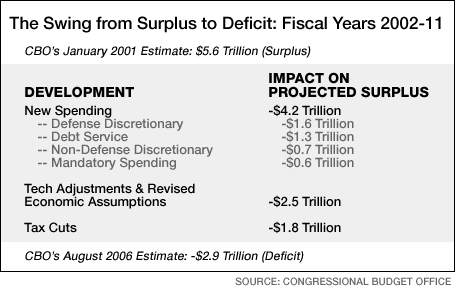
Greg Mankiw, who is a young Harvard economist posted something today that should give all economists pause. The chart above explains why the US budget shifted from "surplus" (In the way that the government accounts for its dough it does not have to follow the rules on unfunded liabilities that other economic entities do) to deficit.

The largest factor in making the change is changes in assumptions and technical adjustments by the economists. That amounts to almost half of the originally projected surplus. Mankiw has some interesting stuff on his blog in case you want to check it out.

Translations

Senator Russ Feingold announced today that he would not be running for President in 2008. Here is what he said -

"I believe I can best advance that progressive agenda as a senator with significant seniority in the new Senate serving on the Foreign Relations, Intelligence, Judiciary and Budget Committees."

Here is the same sentence translated into English -

I have decided not to run for President in 2008 because I don't have a snowball's chance in hell of being nominated much less elected, in the US Senate with us in the majority I can pursue my narrow political beliefs."

Sunday, November 12, 2006

The Queen


We saw the Queen this afternoon. It is a wonderful movie. The story surrounds Elizabeth II's reaction to the death of Princess Diana and of the ascencion of Tony Blair to the PM, all in 1997. Helen Mirren, who plays the queen, has the distinction of being the only actress who has played both Elizabeths.

The movie is, if anything, understated. The genuine tensions of a monarch that has served for more than 50 years are evident when she learns that Diana has died. The Queen is skeptical of the new PM. But indeed in the end she accepts good political advice from the new PM about how to get out of the perceptual problem the royal family encountered when trying to balance political/public responsibilities with those private functions associated with the death of a family member who had been divorced from Prince Charles.

The interactions of the characters are wonderful. Blair and Prince Phillip and Prince Charles are masterfully played. Their interactions are also well presented. Oddly, Prince Phillip is portrayed by a guy named Cromwell. Mirren should be a contender for the Oscar this year - she plays the role with almost perfect detachment.

Moderate Republicanism, a footnote

In the 1970s I was the Chapter President of a group of "moderate" republicans called the Ripon Society. Ripon was made up of a strange mix of people. I would say the thing that bound us together was a strong commitment to ideas. We spent a lot of time working on new policy approaches to various public areas. When I was chapter president we had some very interesting discussions about major ideas - we were very committed to a volunteer army and some interesting ideas about tax policy (many of which were ultimately reflected in the 1981 and 1986 tax acts). We also believed in incentives rather than mandates. Finally, there was a strong blend of social justice in our thoughts.

Some of Ripon's leadership became prominent. George Gilder, who I remember as a bit daft, went on to be a successful policy writer and then a techno-prophet. In one of our national board meetings, George was supposed to be there but kept missing the airport all weekend. We kept getting phone calls that he had flown to New York (where the board meeting was) only to have gotten lost in thought when the plane landed and then carried off to some other place (Hartford or Cleveland were two places that I remember). All weekend we had a picture of a guy who kept getting so caught up in his ideas that he forgot to get off the plane. Patricia Goldman became a member of the National Transportation Safety Board and has stayed in Washington for a variety of public policy activities.

In October of 1973, we held a fund raising auction almost immediately after the Saturday night massacre. We raised a lot of money because we had secured a doodle from Elliot Richardson, who had been axed the weekend before as attorney general. It was at that time that I began to think that Robert Bork was a lot less than he portrayed himself to be. (When he was nominated for the Supreme Court I thought he would have been a lousy justice, but that is another story.)

Ripon's members began to drift apart about the time that I left Washington. They drifted into three distinct groups. One hand drifted toward libertarian philosophy. As the 1970s and 1980s progressed some of us saw increasing evidence that massive government programs are prone to rent seeking and other failures that economists like James Buchanan and Gordon Tullock began to point out in the literature of public choice. A second group drifted toward the democrats. Charles Goodell, who was a senator from New York, would have probably moved there had he lived. Certainly, his wife seemed to move toward that direction. Although one wonders how comfortable some of those people were in their new roles - the democrats increasingly moved away from a support for some conservative principles. Finally, there was the group like Jim Leach, who was defeated on Tuesday, who stayed in the republican party. That branch seems to have been pretty much obliterated in Tuesday's election. But then some of us thought it was many years before this one.

Saturday, November 11, 2006

Borat the Philosopher


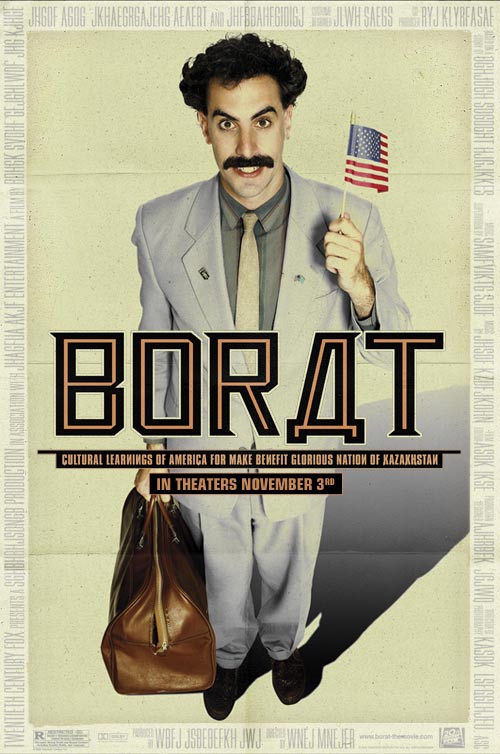
My son and I went to Borat the Movie today. The movie has some funny bits, but I was impressed how quickly I concluded that I got his joke. It seems to try to offend a large number of groups in society, often without a seeming purpose. This is not satire, it is a series of jokes that seem designed to shock the audience. It soon became predictable.

What was most interesting to me was my son's reactions to the movie. As we were walking out of the movie, I asked him what he thought. He compared it to an entertainment vehicle when he was about 14 - Beavis and Butthead. He reminded me of when we went to their movie, which had many of the same qualities. Devices designed to shock but not a lot of thought about the long term structure of the movie or the message. In many ways he believed that Beavis and Butthead or South Park was a bit more carefully constructed. I think he is right.

Comedy can often offend out sensibilities. Lenny Bruce would be pretty tame stuff today. But unlike Bruce, Sascha Cohen does not seem to be thinking about anything than the next tasteless joke. There is a lot of controversy about both whether the script was in fact the creation of Cohen and also whether some of the candid scenes were actually obtained with the consent of the people in the scenes. Cohen used former Congressman Bob Barr and former Senate Candidate Alan Keyes. I am not sure why either of those guys agreed to be in the movie.

In the end this movie is a disappointment. What was interesting to me was my son's thoughtful response to what the movie offered. I was impressed at his thinking.

Borat, the politician


Over the last couple of days I have been exchanging views with an old friend who is convinced that the election told a story that I simply do not see. This afternoon, my son and I saw Borat the movie, and I began to think about my friend's views. Borat is a fairly shoddy characture of a foreign visitor. I believe my friend has made a fairly shoddy characture of what happened on Tuesday. He believes that the change which suggested in part.

"As to the GOP moderates you dislike, well, they were the linchpin for the GOP majority in Congress, and those seats will not come back. So there is no way the GOP wins back the House in 2008 or anytime in our lifetime. They have maxed out in the south and will continue losing in CA (Dreier is next) and in the moutnain west and mid-west. So I don't really care about the GOPers in the House, they don't matter anymore. They will be as irrelevant as the legislative GOPers."

This guy calls himself a Republican, which I do not. But he is absolutely apoplectic about the war in Iraq. (He is a Vietnam vet and draws some kind of parallel to the conflicts, which I at least do not find.) Thus, he revelled at the loss of the GOP and is absolutely ecstatic about the prospect that the democrats like Waxman will begin a process of investigating the administration. He was giddy about an effort by some minor politician in Germany to try to go after Rumsfeld under some bizarre theory of universal law. He actually compares Rumsfeld to Pinochet.

Both congressional parties are a lot like the reality that is created in the movie. Borat is a mildly offensive reality (sometimes more than mild). The American people clearly said on Tuesday that they disliked the reality of the GOP leadership. But as I have thought about it, where I differ from my friend is where that dissent manifests itself. I believe that the election was about corruption both personal (like Foley - although I think his personal situation changed very little in the election and institutional - Congress' standing is even lower than the President's). The problem for the republicans was in part based on their leadership style. They don't have that any more. We knew how Hastert and Frist would react to questions. We are not so sure about how the presumptive leader in the house (Boehner) and the Senate will react to the events of the day. We do know how the Administration will react, but in the last two years of a term many presidents become less relevant. What we do not know is how the new leadership in the House (Pelosi) will react. Pelosi is not a pragmatic leader. She has a cast of senior people who will chair committees who are significantly more liberal than the country. But she also has a large addition to her caucus who are a lot less committed to her point of view. On the GOP side, especially in the house, there are a lot fewer "moderates" and even some of the firebrand conservatives. (Don't underestimate the effects of the Hayworth loss.) In the Senate we know about Harry Reid. He, like the GOP leadership in the last congress, has the ability to operate on the brink of legitimacy.

So what happens in 2007 or more importantly what would my friend suggest? On the war. What specific would my friend do NOW to change - would he move us out immediately. Would he reinforce the notion across our enemies that when the tough gets going that we cut and run? There are indeed ideas that could be presented as alternatives to the existing policy in Iraq - but our realistic alternatives are quite limited. A lot depends on whether you believe that the primative Islamic forces are a long term threat to our way of life. But ultimately, while the American people are uneasy about the current strategy, I think they will also be uneasy about a disengagement that seems to cut and run. This is not an easy issue for either party.

On taxes, my friend has constantly nattered that the tax cuts of 2001 were wrong. But exactly what would he do differently? Would he raise the rates on capital gains and thus lower capital investment in the economy? Would he revert to the 2000 levels of inheritance taxes? Indeed, the last Congress, the realistic alternative to inheritance taxes was a significant increase in the exclusion (perhaps $5-10 million) and a retention of step up basis for remaining estates. If the dems forget that potential - they are likely to pay a heavy price in 2008.

Does he support, what seems to be the majority position in the democrats, the idea that free trade is a negative for the economy? If he does has he bothered to look at the long term economic effects of free trade on our economy?

Politics is ultimately the art of the possible (according to Bismarck). In this case a couple of things are clear about the results of the election. First, the GOP moderates, who have been a dying breed for the last two decades (I was actually a Washington Chapter President of the Ripon Society in the 1970s so I know something about "moderate" republicans), are dead. Second, that means the GOP is a bit more conservative than the last session. Third, the democrat caucus in the House is a bit more conservative than they were in the last Congress. There is clearly an issue for the democrat leadership between the liberals in the leadership and the new members who are a bit more conservative.

My friend is blinded to see that only one policy determined the outcome of the election. I also believe that much of the media also have that problem. Does that mean the GOP will recover these losses? I am not sure at this point. A lot depends on whether Pelosi and Reid are smart enough to listen to the new members of their respective houses. A clear message of Tuesday's vote was that the American people are very grumpy about the work of the Congress. If there is a perception that either side is obstructionist the penalty will be levied in 2008. At this point, both sides have an opportunity to define their field of play. Bush also has the opportunity to think more creatively about what will work in his last two years.

Borat is a disappointing movie because it intends to offend without worrying about its long term message. Unfortunately, the simplistic notions that this was a ground changing election has yet to be proven. The next several months will determine whether the simplistic notions raised by my good friend will come true. At this point, I believe they will not. But if the GOP believes they can continue what they did last year, they will be vanquished. If the dems assume that a minor victory is a long term mandate they will also be rejected just two years hence.

The Iraq War as a motivator in the election

The Bush administration's rapid dropping of Secretary Rumsfeld the day after the election suggests an administration in disarray that misread the election results.

Clearly, the pundits and the pollsters and the loon left believe that the prime motivator in the electoral loss that the GOP suffered on Tuesday was caused by concern about the war in Iraq. I think that is incorrect. When you start out with a 43% approval rating as president you are pretty sure that the GOP will not be a strong force in an election. 61% of Americans disapprove of the way Bush is handling the war in Iraq (according to the Newsweek poll). But here is the rub. The pollsters believe that the 61% is monolithic. I do not think it is. Any democracy has little stomach for any war. Look at polling during even WWII and as the war continued support for the war began to fall - not to the levels of the Bush era but it fell none-the-less. I would argue that the 61% can be divided into at least two groups - some percentage of the voters disagree with the tactics of the war but agree with the notion of confronting the terrorists. A tiny percentage of voters might even suggest that we should pursue the war objectives more aggressively. But the notion that the war was THE motivator for the election is simply false. If one looks at the GOP members who lost on Tuesday and were the most aggressive in opposing the war, almost two thirds of them lost. Clearly, if you were GOP and against the war, you fared worse than the rest of the party. So in my mind there was something else going on. In several cases a GOP opponent to the war lost to a slightly more supportive democrat.

I believe the motivator of this electorate was Congress. In the most poisonus atmosphere in the US (Rhode Island) Bush had a 22% approval rating while the Congress had 15%. The national numbers were not much better. National polling was similar - in one poll 74% of Americans thought Congress was out of touch. That made Bushs' 43% positively stratospheric.

What caused that change? In my opinion, the factors I listed the day of the election caused it, namely a perception (which I believe was correct) that Congress was burdened by corruption (Abramhoff and earmarks) and a tin ear (the silly efforts this summer to bring up hot button issues rather than to pass legislation). The Public Choice analysis of politicians seeking rents from the voters, was especially pronounced in this cycle. The voters believed, and in this case I think correctly, that Congress was not in it for improvements in the country but for narrow and personal motives. That caused some perceptual changes which are significant. For example, according to the Rasmussen poll "Americans today still hold views similar to those that brought Reagan to the White House—61% believe that tax hikes are bad for the economy. Just 16% believe they help the economy." But surprisingly in this cycle the advantage that the GOP had on this issue, dating to the Reagan era has faded pretty significantly. That was an area where the GOP fought hard to support an area which the voters overwhelmingly favor, but because of the perception on corruption and dilly-dallying they lost a clear advantage.

Here is a good example in my own area. Two congressmen next to each other Dan Lungren and John Doolittle come from similar districts in terms of registration. (If anything, Doolittle's district is a bit more heavily GOP.) Lungren went back to Congress and one of the first campaigns he fought for was to end earmarks. Doolittle was right in the middle of the defects of Congress - he was tied to Abramhoff, his wife was (is) collecting a commission for all of the money raised in his behalf, etc. Both candidates were equally supportive of the war and both candidates had an opponent who was against the war and used the war as a major issue. On Tuesday, Doolittle squeaked by with about 49% of the vote. Lungren received almost 60%. Clearly, the difference was not the war but the perceptions about Congress.

That brings me to the Bush action to oust his Secretary of Defense. Bush acted quickly, after the election, to throw Rummy under the train. In my opinion his move made no political sense. I am not a fan of Mr. Rumsfeld. But if the President thought Rumsfeld was a liability, what would the effect of a change in the position had on the election had he done it before rather than after? Doing the job after the election makes the President look like he is panicking. In this case I think he is responding to the wrong stimuli.

The California governor faced a similar problem a year ago and yet won re-election by almost 60%. (Even with that percentage he seemingly had no coattails - the one GOP candidate who won statewide had an opponent who was damaged goods. California is still a pretty blue state, in most ways.) The Governor learned that the voters kind of liked his willingness to get the legislature to go along with him. Although I have not seen polls on it, I suspect the California legislature's perceptions have improved along with the Governor's.

Friday, November 10, 2006

What does competence have to do with it?

My predecessor in the Association that I work for joined us for our annual meeting over the last two days. I asked him to help us think about accountability measures for higher education - to listen to our discussions and then offer a slightly distant sage's perspective. He did a superb job. Colleges and universities are entering a new era where they need to be more transparent. Many in higher education do not understand that perspective - but our discussions helped my members begin to think about how we can resist those calls for more information that are silly and at the same time be proactive in living in this new world.

But as I was driving him back to the airport he told me that he is one of those people on the TSA watch list. Mind you this guy is 75 years old, has a PhD, was a college administrator for a good part of his career. But the TSA has him on the list - that means more hassle when he wants to fly. But to get off the list is even more trouble. So he puts up with this minor inconvenience because it is not worth the trouble to correct it.

But here is the rub. He is a vehement opponent of the President's policies in Iraq. He has been quite vocal to me and others about his position. None of this is any the bit outside of normal bounds of reasonable discourse. I think the President has been a lousy protector of budget integrity - domestic spending has been rising at a much faster rate than college costs. So I am critical too of this president. But this guy is profiled. So the TSA for whatever reason takes this 75 year old, highly educated, retired moderate and labels him a terrorist. My lord he is a regular reader of The New Republic.

He speculated that he might be in the group because he has a "daughter" who is Turkish; he had a student from Turkey live with his family and they have remained close. He has been critical in emails to his family including his former exchange student "daughter" - he thinks that might have been the thing. I think the explanation is more simple. His name is Moore and I am sure that the explanation is that the TSA morons believe that he is a moslem from Spain. (Moor)

Thursday, November 09, 2006

Chocolate Election

George WIll pointed out something I did not know about the election -

About $2.6 billion was spent on the 468 House and Senate races. (Scandalized? Don't be. Americans spend that much on chocolate every two months).

Grading myself

Last night I posted something about how the pundits did on projecting the election returns. But how well did I do in analyzing the events of Tuesday in advance? I have always been careful not to put much stock in elections projections before they have formed - for me that means anything more than two weeks before an election is mostly speculation. Second, I was a bit more forgiving for the GOP than the rest of the populace. When I did get around to thinking about who would win and who would lose I thought the GOP would hold the Senate. (And for a few thousand votes, they would have) But I thought it would be by a bit higher number than even that - perhaps in the 52 range.

One of my friends who is much more into the daily drama of elections was also off. He thought there would be a massive wave that would swamp the GOP. He is a Vietnam vet and seems to be very animated about the President's war policy. He thought that, coupled with the scandals in the GOP, would produce some pretty dramatic results. In the end, I do not think that happened. This was not 1974, or for that matter 1964 or 1966. I would argue that although the American people are very concerned about Iraq, the influence issue on the election was minimal. Indeed, one can argue that in several cases (Chaffee for example in Rhode Island) the voters chose the more hawkish position. Even in the Virginia senate race I think the final result was less about war policy than it was about Allen's inept campaign. If you look at the most dovish members of the GOP - only two of them survived.

So what moved the voters? I also do not believe, that with the exception of his own district, that the Foley affair moved voters much. I think the equation for this election was a mix of the perception that a good deal of Washington is for sale (pay to play, Abramhoff, Hastert's response to Jefferson, etc.) and a concern by many voters who had supported GOP members that they were not really supportive of limited government.

Wednesday, November 08, 2006

Who was the worst pundit and the best for 2006?

This is a pretty exceptional group but for my money one might look to Bob Novak. On the Sunday before the election he released a list of four graphics purporting to be the lowdown on what would happen on Tuesday. The house predictions were laughable. He included a lot of house seats which I did not find others thought were in contention. But his senate projections thought the GOP would hold Missouri (a lot of other people did too), Tennessee (he even got that right), and Virginia and Maryland. Thus, he was 0-4 for those key races. Of course he picked Santorum and DeWine and the Minnesota seat, Nebraska, Vermont and Washington and he even picked West Virginia correctly.

A second choice might be Liddy Dole, who ran the GOP campaign committee in the Senate. She simply was not up to competing against Chuck Shumer.

A third choice might be Daily Kos - from his idiotic support for Lamont to all of the other things he did in this election - he thought this was a chance to have a democrat wave. If the numbers hold up, this is not a rout but a bit below what happened to war time presidents since the Civil War.

But there were also some new sites which were quite interesting and added to the discussion. For example one site already began to think about 2008 and the fundamental fights that will develop for that election. The suggestion was that of the 29 seats lost by the GOP yesterday - only ten of them are likely to turn in the next election. In this case the site election projection was actually pretty good. On Election Projection they looked at a similar issue arises for the Senate - where there are a raft of GOP senators who are likely to retire.

Perhaps the most reliable site during this season was the same as the last election Real Clear Politics did some honest review of all of the possible methods of analyzing the election. Two or three times he posted an analysis of what we should know about how to think about trends. Each of these were thoughtful efforts to begin to build a theory of politics.

In the next couple of days, there will be a lot of discussion about what happens next. Unfortunately, there is no consumer's guide to pundits. But as you read them they will begin to sort themselves out.

A Carey McWIlliams Election

Carey McWilliams was an editor of the Nation and a supporter of a lot of left wing causes. And last night's election would have been something McWilliams might have been proud of. In the first instance, the GOP was taken out of power in the House. In the second, several conservative senators were knocked out. The pickup of House seats was a bit less than normal for a president in the middle of a war. Since the Civil War the out party picks up an average of 36 seats in the house. For that to happen the dems would have to win almost every race that is still uncalled.

At the same time there were a lot of things McWilliams would not have liked about the election. Moderate democrats won in several key races. Pelosi may find her new caucus a bit unwieldy.

I thought of McWilliams because for most of the night California was (in the phrase he coined for one of his books) "The Great Exception." The GOP governor won big. So did the GOP candidate for Insurance Commissioner. In several races (Lieutenant Governor and Secretary of State the republican kept it close for the evening. The California House delegation changed by one - Pombo was defeated. John Doolittle seems to have won. He would have been the second turn for the dems. Doolittle gets the churlish comment for the night. He said in one of his election interviews that getting elected to a new term when his party loses the majority was not exactly positive - "things only get done by the majority." What a jerk.

The Senate (where the wartime average loss is 5 seats) looks like it will be decided in the next couple of days. Both the Montana and Virginia seats are probably going to recount. In both cases, at this point, the GOP candidate is behind. That would mean a net pickup of 6 with control also going to the dems.

The key in many races seems to have been moderation - as one blogger commented there are a whole lot more Dinos and Rinos (democrats and republicans in name only). Let's see how that holds up. In a strange sense one of the biggest RINOS, Lincoln Chaffee, lost to someone who was less anti-war and a bit less inclined to jump on certain economic issues. It will be interesting to see how Joe Lieberman presents himself in these next two years. It is unlikely that he will reject the majority position of the dems assuming that they hold on to both seats. But I would expect him to be even more independent.

William Jefferson, the frozen asset congressman seems to have won, although if you count the democrat votes against him (there was more than one candidate) he lost. So did Heather Wilson (NM) and Deborah Pryce (Ohio). Chris Shays (CT) won but Nancy Johnson (CT) did not. The Michigan affirmative action proposal, which is a clone of California's prop 209 (which restricts the ability to use preferences) passed by almost 2:1. Bans on same sex marriage(with one exception) seem to have all passed, as did measures to raise the minimum wage. But so did measures to use English as the official language. Seven of the nine measures restricting eminent domain seizures passed (and in California it was close). Surprisingly the $1 million lottery proposal (give a voter a million bucks) went down in Arizona. Also Arizona and California were mirror images - AZ agreed with eminent domain and rejected cigarette taxes and California rejected eminent domain and rejected cigarette taxes. Arizona also adopted a series of very restrictive measures on immigrants.

On the propositions in California, all of the bonds passed - which will move us very close to a perilous level of debt. And all of the liberal sops (a tax in cigarettes and oil and public financing and a parcel tax for education) failed. The one non-borrowing prop that passed was one to put more restrictions on sexual predators.

If both houses are in control, albeit narrow, of the dems look for some partisan shenanigans. Actually, look for that anyway. But look for that especially if both houses turn. The new Judiciary chair has blathered about instituting impeachment proceedings. I expect that if he does, the houses will revert in 2008.

There were several key local races in Sacramento. The proposal to raise taxes to build a new sports arena (Proposition Q&R) went down to a stunning defeat. Proponents immediately said they were working on a new proposal - maybe this time they will tell us what it is before we have to vote on it! The proposal to expand the service area of SMUD (our municipal utility) also went down.

Finally, there was the razor thin votes in a number of races. Heather Wilson (NM) if she wins will be victorious by 1300 votes. Similar margins are hanging for both the Montana and Virginia senate races. Perhaps the closest race I saw last night was for a State Senate seat in Orange County, where the republican is ahead by 13 votes.

Tuesday, November 07, 2006

The power of the new media


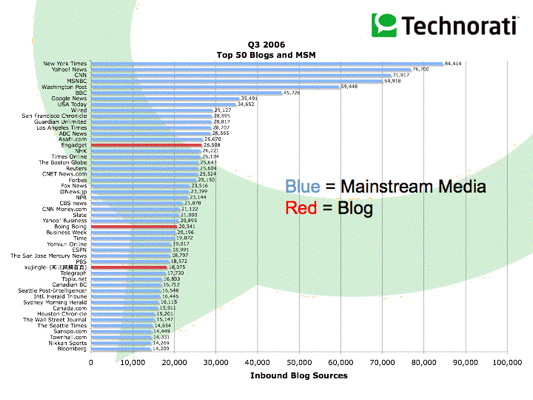
There was a bit of chatter yesterday that Instapundit was worth $35 million yesterday on the web. I read several of the posts but cannot figure out how that number was arrived at. But the chart from Technorati seems to offer some indication that the value of the new media is both currently important and increasing in value. It is an interesting commentary that at some point the venture capitalists are going to notice.

Some pre-thoughts on today's election

Over the last couple of days all of the political junkies, including me, have been trying to build out scenarios about what would happen on November 7.

Instapundit, did one on October 14, which listed many reasons why the GOP would lose on election day. Included in his list were things like the Terry Schiavo affair, the Harriet Miers debacle, the Dubai ports disaster, immigration, the Hastert defense of William Jefferson (the congressman with the frozen assets in his freezer) and the Foley affair. Each of those was supposed to have reduced GOP interest in the election. I think most of those issues, with the exception of Foley, were off the table by the time that today came around.

On the other hand each have an element of truth. I would adjust Reynold's list a bit and suggest that if the GOP loses in the House tonight they should blame each of the following;
1) The Bridge to Nowhere - This congress almost more than any other I can remember has a "pay to play" nature to it. The earmark to spend millions of dollars for a bridge that would serve very few people was indicative of that. But the increasing number of earmarks in legislation is something which I believe turns voters off. I think there is a growing perception that bringing home the bacon is often less about helping constituents than helping re-election.
2) The Imperious Congress - Here one has the appearance of impropriety - but there are a lot of little things. Foley was ousted quickly, as he should have been. His crimes were really much less shocking than either Gerry Studds of Jefferson. But that does not matter. The press was looking for scandal and while the democrats are not blamed for Jefferson (and indeed the GOP got part of the blame because of Hastert's lame defense of House privilege) as they were not for Studds - it does not matter. In the media environment of today the appearance of impropriety for the GOP is enough.
3)The Kabuki Congress - Piled on top of the perception of pay to play was the exercise this summer of a Congress that cared more about symbols than substance. The fight to federalize the Schaivo issue seemed to be one of those issues but so were the fights on flag burning, immigration (although that deserves its own treatment), abortion, and a host of other debates this summer. A lot of what this Congress did was play to the gallery.
4) The Fence - This is a complex issue but Congress seemed to want to deal with it in symbols. Immigration has produced benefits and costs for the country. An intelligent immigration policy would examine those and try to weigh out a good set of policies which would increase the level of benefits while reducing the costs. I think the President's original proposals tried to do that but for a lot of reasons the debate got down to symbols and thus we created the fence.
5) Tragedy TV (and Newspapers) - In the last several years the media has become increasingly irresponsible. Some have suggested that came about because of the 24/7 news cycle but I think it is that plus the inherent bias of most members of the scribbler class. The NYT had a lead editorial which explained why they did not endorse a single republican this time. One would think that would come as a surprise, but it does not. The coverage of major issues, including immigration and the Harriet Miers nomination, and even Foley was done as a series of charactures rather than with substance. The Congress, reflecting the press' propensity, reacted symbolically. A lot of the debate is recognized for what it is - blather - and the American people have increasingly looked at the quality of public discussion and voted no. They are turning off the media in huge numbers and they will increasingly turn off the political class so long as they continue to trivialize important issues.
6) Oliver Cromwell A friend gave me a quote last night which I liked a lot. In 1653 Cromwell commented to the long parliament "You have stayed too long for any good you are doing. Let us be done with you. In the name of God, go" There was a general sense of fatigue in this Congress on both sides. When you are in the majority in a sixth year, you would expect to have some voter discontent. When you have examples of petty and major moral "vercliptions" that add to the fatigue. In the district next to mine, John Doolittle (whose name implies the quality of his work in Congress over many years) said with a straight face that it was OK for him to influence peddle with Jack Abramhoff and OK for his wife to take 15% off the top of his campaign donations. The voters probably won't reject him today - but they should.
7)And finally there is Narrowcasting - I was struck by how narrowly some of the "broad" cast media look to narrow cast their views. Maher is a fine example of someone who speaks to a relative large but narrow segment of the population - but there are so many other examples also. A good deal of the media speaks to itself either from the right or the left. They listen to themselves and then pronounce the same to their decreasingly wide audiences. That reduces the possibility that public discourse will focus on the important issues of the day. The Atlanta Journal article quoted in one of yesterday's posts is a good example of that kind of nonsense. The columnist argued economic wisdom that is unsupported by the facts. One of the most troubling parts of the public discussion is the limited knowledge that the media displays about economic issues. We are in a pretty strong economy - using the normal indicators (employment, stock market, even budget deficit) but one would never know it by the coverage.

And yet what may save at least part of the GOP majority is the perception that the alternative is really the evil of two lessers. John Kerry's pathetic attempt at humor or a barb last week brought new energy into a lot of races. Robert Samuelson commented last week that he believed "the republicans deserve to lose, but the democrats do not deserve to win."

Monday, November 06, 2006

Economics One A - for an Atlanta Columnist

Cynthia Tucker does not like globalization. In a column this morning she comments -

"Meanwhile, a more insidious force — globalization — has eaten away at our economic infrastructure. For 30 years now, global competition has been quietly gaining on us, melting the broad base that lifted so many Americans into the middle class. Steel mills are shuttered; textile plants have disappeared; domestic automakers are in their death throes.

Those lost jobs have not been replaced by work that pays as well or that grants health insurance and pensions. The unemployment rate — a low 4.4 percent — doesn't account for the fact that many of those jobs are at Wal-Mart and McDonald's."

I guess Ms. Tucker has not ventured outside her office in Atlanta to see all of the good benefits coming to Georgia from globalization. She certainly has not looked at any numbers.

After a lot of blather she concludes with "The war on terror is certainly important. But so is the war against economic decline, and we're losing that one." Ms. Tucker please go to Cafe Hayek and get the reading list. Read the books. Then look at the Dow. Understand that the ownership of equities in the last 30 years has increased dramatically. So, indeed, some old industries have declined. Although if you want to look at the auto industry here, don't look at Michigan, which has had a legacy of lousy public policy and some pretty lousy management, but look to South Carolina (are the textile jobs better than the jobs for BMW?), or Tennessee. Finally, she might look to the Bureau of Labor Statistics. It might be useful for her to bone up on her statistics too. She comments that the median income in the country is $46K - according to the census in 2003 she is about $20,000 low. But when you write like she does, facts do not count.

One of the benefits and one of the costs of a dynamic economy is that things change. But the evidence on globalization is that the changes have been more for the good than for the bad.

Sunday, November 05, 2006

Bringing the last several posts together

I guess what I have objected to in this election has been the increasing "mahering" of electoral discussion. There are real issues that voters should be addressing and yet at many levels voters are not often being presented with those real issues. Maher and Spellings are two peas in a pod - present a show not a substantive discussion of important issues.

But then there are the overly aggressive proponents - I did a short post on Kuttner. I am not sure why people listen to him or his counterparts on the right. His paranoia certainly does not enhance the quality of public discussion.

Finally, there is the media. (or is it more properly Medea?) Reporting the news is a hard job. But we are often stuck with hacks who figure that the editorial page is too hard to find and so they sprinkle it all over the rest of the pages. That certainly does not contribute to public discussion.

Ultimately, any representative system will fail if we allow public discussion to decline in quality and substance. Indeed, there are lots of ways to look at the world. And there are times when strident public posturing is appropriate. But what passed for electoral discussion in this election was too much of that posturing and not enough of the real engagement that the voters deserve. One wonders why turnout is expected to be as low as it is. Or does one?

Is it news or MSM?

Presented below are the headline and some quotes from a story in the Washington Post this morning, and one wonders why the Post is accused of being slightly partisan.

Headline - Democrats, on the Offensive, Could Gain Both Houses

Lead Paragraphs -In the battle for the House, Democrats appear almost certain to pick up more than the 15 seats needed to regain the majority. Republicans virtually concede 10 seats, and a split of the 30 tossup races would add an additional 15 to the Democratic column.

The Senate poses a tougher challenge for Democrats, who need to gain six seats to take control of that chamber. A three-seat gain is almost assured, but they would have to find the other three seats from four states considered to have tossup races -- Virginia, Tennessee, Missouri and Montana.

But later in the story we find that - A new Washington Post-ABC News poll shows some narrowing in the Democratic advantage in House races. The survey gives the Democrats a six-percentage-point lead nationally among likely voters asked which party they prefer for Congress. It was 14 points two weeks ago, but this remains a larger advantage than they have had in recent midterm elections.

Were I to have written the story I might have highlighted the closing of several key races. Who knows whether this trend is real? But it is annoying to have a major newspaper so blatantly ignore the real lead of the story. I guess that is part of the reason why so many papers are seeing declining circulation.

Saturday, November 04, 2006

Robert Kuttner, Pundit

Here is what Kuttner said in the Boston Globe today.

"[U]nless there are levels of theft and fraud that would truly mean the end of American democracy, a Democratic House seems as close to a sure thing as we ever get in American politics three days before an election... November 2006 will be remembered either as the time American democracy was stolen again, maybe forever, or began a brighter day. "

Well, I guess we do not need to have the election.

Bill Maher, Sophist


Last night, I had the opportunity to somewhat involuntarily listen to Bill Maher. Maher, BA English Cornell, 1978, parades as an intellectual. Indeed, he has a pretty quick wit. But his commentary is a mix of tendentious rants with occasional humor.

The format for Maher's show is a lot of blabber with a somewhat feckless opponents and a syncophantic audience and crowd of groupies who salivate every time he scores a point. Like Bill O'Reilly, BA History Marist, 1971/MA Boston 1978, he really does not care to engage in substantive discussion about important issues. But in O'Reilly's case there is not the premise of intelligent debate.

One of Maher's favorite themes is the relationship of religion and life. Last night his argument was that the institution of marriage is really unnecessary in "modern" societies and that there is no difference for societies where there is no formal sanction of long term relationships which encourage the care of children. One of Maher's charms, is his ability to set up false premises and then knock them down. In this instance, he went on to argue that those who support the institution of marriage automatically oppose any standing for unmarried and same sex couples. That is nonsense.

Unfortunately there is pretty good evidence that societies which value marriage have lower levels of child abuse and other indicators of stability in society that are desirable. Maher ignores that. Institutions like marriage are for general not specific purposes. That means while such conventions offer society general benefits, and they do; those benefits are not present uniformly in society. Neither should one believe that in supporting something like marriage that one would automatically support additional rights of property transfer for non-traditional relationships or for official sanctions for individuals who make alternative choices.

In the end, Maher did a rant which gave the democrats four or five answers to the GOP's claims against them in this election. Any partisan republican would welcome those as the key themes. But they were like Maher's show - evidence that Maher actually does not care to engage in real policy discussion and lives in the very narrow world where he only hears from a set up audience. I wonder how Margaret Spellings and Maher would get on in a discussion where no one was watching.

Friday, November 03, 2006

A conference on student success

For the past couple of days I have been in Washington at a conference organized by the National Postsecondary Education Cooperative (NPEC) which is a loose group of researchers and other people interested in better data for higher education.
There have been a couple of highlights.

On the first day, the Commissioner for National Education Statistics, in a role that was supposed to introduce Derek Bok who as the interim president of Harvard has cache to speak in almost any higher education assembly, veered off course to do a rant for something that people in the National Center for Education Statistics want (something called Student Unit Record Data or SURDs). The Commissioner made the comment that in essence if we just had a record of every student in the country we would have milk and honey and would know everything we need to know about student success. Unfortunately for him, there are a lot of people who have looked at this massive federalization of higher education and think it is a lousy idea. The issues of cost, and privacy and alternative uses are just a few of the reasons why this turkey should never fly - but the Commissioner felt compelled to throw in his pitch for it.

In that first afternoon I participated in a panel with a pair of researchers from Indiana's highly rated higher education program. They presented a very good review of the literature on what improves the chances for student success. In one sense the answers are apparent - students who are more involved (fulltime, and involved in campus activities) and who have a sense of belonging are more likely to complete their studies than those who do not. Also, students who do not have worries about money (adequate financial aid) and who come to campus well prepared are likely to finish. I was on the panel with the new president of Tennessee State, who is also an economist. There were no fireworks here and a pretty broad concensus about the correct direction of the research. Part of the problem we face is that increasingly students come less well prepared and less committed to attending fulltime. In my mind higher education can help increase chances for success by controlling its own environment - which means encouraging ways to bring students into the life of the campus by offering key courses in the first and last year and offering a lot of activities but also in mentoring students through the process. On the outside they need to figure out how to be deeply involved with their public schools and also to be strong advocates for financial aid.

Yesterday, we heard from Margaret Spellings, the Secretary of Education. It was a controlled experiment in communication. Spellings created a national commission on higher education, that among other things supported the SURD idea. (I wish I could think of an A and a B for the beginning of that acronym because then it would correctly point out the nature of the idea.) I say controlled because the Secretary was only willing to come in at the end of the lunch. She spoke and then answered only a set of filtered questions. Even with that, which was recorded by C-Span, she dodged some of the issues. I am increasingly impatient with public officials who are unwilling to engage. The Spellings Commission has some ideas that need to be tested but that will not happen without a direct involvement by the principals like the Secretary of Education. The whole event made me think about how wrong it had been to create a federal department. But that is a genie that will never go back in the box.

Spellings again repeated the argument that one cannot get the same kind of "consumer" information about higher education that you can get when buying a car. That is a great sound bite but untrue. In the middle of the summer when I first heard of her making the claim, I went online and in about two minutes found tons of information about colleges in a particular area. Spellings claims that what she wants is surety about final price for higher education (you cannot get that for cars either because ultimately when buying a car there are many prices) and the same thing for admissions (in this case part of the process of choosing higher education requires the college or university to make a choice about you. Last time I checked car dealers do not review qualifications for car buyers beyond their credit. Similarly, while a buyer of a car can see the sticker price before you plunk down dough - the final price remains hidden until you negotiate. In the college situation - most colleges give prospective buyers a pretty good understanding of financial aid - and thus anyone with a reasonable amount of energy and intelligence can get a pretty good estimate of final cost. So the analogy is a false one.

Higher education is a complex set of institutions - those who use it come to us with differing motives and backgrounds. No wonder it is complicated. One size does not fit all. But in Spellings' notion one size does fit all. I am increasingly tired of people who want to excessively simplify. It is especially troubling with this "public" official because she thinks engagement on issues is in set up events.

What was most interesting about this conference was the depth of activity on the issues of student success. There is a lot of activity trying to figure out ways to assure higher levels of success. And as you would expect when there are vast differences in the types of institutions, there are also some distinct and vibrant threads developing that respond to the specific differences in types of students and institutions. In Spellings' vision, one size fits all. That certainly is the notion of No Child Left Behind - the act that currently controls elementary and secondary education. That probably does not work for K-12 and it certainly will not work for higher education.